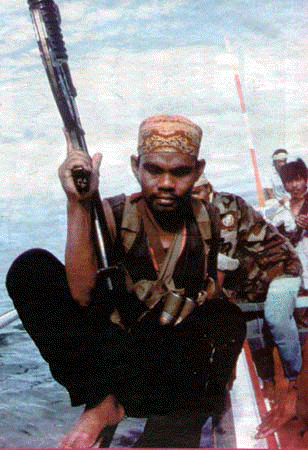
tuque /tūk/ n Canadian English, var. toque [19th c. Canadian French, from the French toque, from the Basque tauka] 1 A close-fitting knitted cap, often with a long tapering end or tassel or pompom. 2 fig Something quintessentially Canadian.
souq /sūk/ n from the Arabic سوق var. souk 1 An open-air marketplace. 2 fig A central meeting place for the circulation of news and ideas.
Showing posts with label Somalia. Show all posts

Tuesday, November 10, 2009

Somalis dialing out for a good time tonight

Bil Farah is a 25-year-old unemployed high-school grad who has already married (and divorced) nine women. Halima Osman is a 20-year-old divorcee and mother of three who says that her last elopement was the best thing that ever happened to her. Both are on the prowl again, and both have their cell phones charged.

It's all too easy to overlook the newsworthiness of daily life in Somalia, where there hasn't been a government in two decades, an average of 20 civilians are killed each day from factional wars, and pirates steal all the international headlines.

With all that strife, Somalis must not be having much fun, eh?

Hardly. Over the last few years a new social trend has swept the capital Mogadishu: consensual temporary marriage.

As one man says, you don't need 11 camels and an AK-47 to marry a Somali gal anymore. Just a cell phone.

Apparently, young Somalis are increasingly hooking up over cell phones, arranging consensual marriages by text message for as little as a night or as long as a few months.* The marriage part allows them to keep right by the Qur'an as they engage in adventurous sexual escapades to distract each other from the daily realities of living in Somalia. (And adultery is, in areas ruled by certain factions, punishable by public stoning.)

It seems the daily barrages of gunfire that ring out over the city of Mogadishu offer the perfect excuse to elope: no one is expected at work or school, so off they go to lover's lane.

* The sources I've found so far do not provide detail as to how marriages are solemnized and where Somalis get phone numbers of prospective partners, two pieces of information that would round out this news item. If anyone has heard more, please let me know.

Monday, October 5, 2009

New Pirate Party of Canada has Somali Pirates baffled

The new Pirate Party of Canada (PPoC), the latest incantation of single-issue politics in Canada's crowded constitutional chorus, may yet succeed in its stated goals of reforming copyright laws and regulating Net neutrality. But it has already succeeded in one undeclared goal: confusing the hell out of Somali Pirates.

The PPoC also wants to blow down the metaphorical walls between peer-to-peer file-sharing over the Internet. Its members aim to drop anchor in the harbour of artists' rights to share their music freely. They want to see the proponents of Canada's corporatized patent system walk the plank.

And therein lies the Somalis' chagrin: the gratuitous use of figurative language.

"Apparently they're into sharing things and relaxing the restrictions on sharing," said a Somali Pirate spokesman who asked not to be named. "We're not sure what is going on, but clearly a bunch of computer nerds are running around claiming to be pirates when they've never even taken over a ship and held it for ransom."

The spokesman wailed over the slow summer on the high seas. "It's been a really tough season with all the monsoons and the global recession affecting the pleasure-cruise industry. But we're making a recovery this autumn. And just about the last thing we need right now is competition from Canada."

Asked to comment on the juxtaposition of the pirate metaphor in the Canadian political spectrum with the infringement upon civil liberties of de facto Internet regulatory policies in a post-industrial globalized commercial society, the Somali Pirate spokesman said only that, "you people obviously have too much free time and not enough real problems."

The Tuque Souq tried to reach the PPoC for comment, but the line was jammed with bit-torrent downloads.

[Tip 'o the hat to Dean for the scoop.]

Wednesday, June 10, 2009

Hollywood plans Somali Pirate movie

Last month a group of elderly pensioners cruising the ocean before death fought off a potential pirate hijacking in the Gulf of Aden. With a "dagnabbit" here and a deck chair thrown there, the feisty septuagenarians scared the Somali pirates into submission, and the latter withdrew their assault.

That's just the kind of gumption that Hollywood is hoping to turn into box-office gold next year when it brings the Somali Pirate saga to the big screen.

Film producer Andras Hamori (Big Nothing; The 51st State) has secured the rights to the life story of Andrew Mwangura, who's sometimes referred to as the "Pirate Whisperer"; as the director of the East African Seafarers' Assistance Program, he and his outfit have an uncanny knack for tracking and breaking the news of pirate activity.

And Samuel L. Jackson will be cast in the lead role.

Opposite the hero will probably be a villain in the form of Ali Mohamed Ali, the infamous pirate negotiator and some say the mastermind behind the so-called chaos of Somali piracy. Wily, crafty and a step ahead of everyone, Ali is the perfect nuanced mirror-image of Mwangura.

Tuque Souq casting suggestion: Adewale Akinnuoye-Agbaje

Other actors needed: Winona Ryder (as the investigative journalist), Sean Astin (as her cameraman), Jack Black (as hostage #1), Mos Def (as hostage #2), Harold Perrineau (as the Somali pirate captain), Jean Reno (as the President of France), Chris Cooper (as the arrogant captain of the Shipriders), Tilda Swinton (as the UN negotiator), Paul Sorvino (as Colonel Muammar Qaddafi), and a cameo by Denzel Washington (as the reclusive philosopher pirate king).

Producer Hamori will also need a director with thriller cred and experience crafting multi-layered stories.

Tuque Souq directing suggestion: I know a lot of people would say Tony Gilroy, but for slightly understated action that preferences dynamic storytelling, let's say Stephen Gaghan.

The hard part will be writing a script that respects both the elegant complexity of the whole institution of Somalia Piracy and the inane simplicity of a band of shoeless Somalis hopping an outboard with an RPG and taking down a two-million-tonne freighter.

Tuque Souq screenwriter suggestion: J.D. Zeik, aka Ronin-writer.

Not a bad lineup. But if the Tuque Souq is hired as a consultant, we'd be tempted to lob the entire project to Noah Bombach, celebrated writer/director of Kicking and Screaming, The Squid and the Whale, and Margot at the Wedding. To the delight of audiences, this would result in a respectably concise and verbose 97-minute film in which the pirates all live together after their heist and figure out what they want to do with their lives, realizing after some agonizing personal reflection that the world might just be as messed up as their worst fears, and that this is okay, really, because it is the process of the discovery of one's own flaws and insignificance that is the true essence of... piracy.

Not to mention this scene:

Hostage #1: "Oh, I've been to Mogadishu. Well, I haven't 'been to Mogadishu' been to Mogadishu, but I know that thing, that, 'Stop shaving your armpits, buy a matching set of RPGs, date a warlord, now I know how bad American imperialism is' thing..."


Hostage #2: "They have good coffee there."

Hostage #1: "... 'how bad American coffee is' thing."

Thursday, May 7, 2009

U.S. court still 12 Pirates short of a jury

Would you steal a loaf of bread to feed your starving family? Sure you would. But say your family didn't like bread; they liked boats. Would you steal a boat to feed your starving family?

A Somali mother pleads for her boy, Abduwali Abdukhadir Muse, who was captured by U.S. navy SEALs in their life-imitating-Hollywood rescue of an American freighter captain off the Somali coast.

The boy (who may be as young as 15 or as old as 18; alas, his Pirate's License was lost at sea) will stand trial as an adult. And why not? If you're old enough to hop into a skiff with a crew of emaciated, shoeless desperados, you must be old enough to stand up to a jury of your peers.

Therein, quoth the Bard, lies the rub.

Not only do U.S. prosecutors need to dust off some very old laws pertaining to piracy (see Union Government v. Confederate Pirates, 1861), they need to find a dozen peers of Mr. Muse to render justice.

Apropos of which, the FBI has put out an All-Points-Bulletin for twelve pirates to serve on a jury for the accused.

According to a statement, the shortlist includes: Long John Silver, Captain Hook, Blackbeard, Redbeard, Bluebeard, Sir Francis Drake, Captain Jack Sparrow, Anne Bonny, Mary Read, Grace O'Malley, Captain Morgan, and Mistress Ching.

HOT OFF THE COLD PRESS
Meanwhile, on the home front, Canadian newspapers continue to miss the boat on the pirate story, especially now that Canada's mission in the Gulf of Aden has been extended.

"Canada's Piracy Folly," whined a Winnipeg Free Press editorial, calling for Canada to get tougher on pirates like the Americans and French. "There is no one that the pirates would rather be caught by than Canadians," the article deadpanned.

"Canada's duty on piracy," said a Toronto Star editorial, is to curtail this pussyfooting "catch-and-release" policy and "buff up the handcuffs."

Is it a coincidence that the Star and the Free Press are landlocked papers? Because the one good (albeit brief) angle on the story lately has come from the Halifax Chronicle Herald:

"It needs to be said there is ample evidence of foreign fishing vessels, primarily from the European Union and Asia, having ravaged fish stocks – valuable tuna, in particular – for many years in Somalian waters."

That's a relatively muted version of the whole story: that decades of exploitation of Somali resources, coupled with ruinous attempts by the West (and Ethiopia) at nation-building, have left Somalis with little else to conclude but "a pirate's life for me"; that illegal foreign fishing in Somali waters--the 'other' piracy--has robbed Somalia of more than shoeless pirates like Abduwali Abdukhadir Muse could ever hope to recover.

ONE MORE FREE LINK FOR THE ROAD:
NPR's recent angle on the story: That Somali pirates, hard-up for Swiss bank accounts, have taken to depositing collected ransoms on the sea floor, for later withdrawal.

Sunday, March 22, 2009

Somali Pirates prefer microwave dinners to Cordon Bleu

From the current issue of Vanity Fair, an article on the anatomy of the Somali Pirate hijacking of the French cruise boat Le Ponant, authored by Tuque Souq favourite William Langewiesche.* In 2008 a handful of Somali pirates seized Le Ponant and held the boat and its crew of 30 French men and women for ransom. The article, long and wonderfully thorough, is called: "The Pirate Latitudes":
Soon afterward [Captain] Marchesseau’s hopes for the pirates’ imminent departure were dashed when additional gunmen arrived carrying large quantities of cigarettes and supplies, which they began unloading onto the marina platform. The food was crude but not beneath comment by the French. It included disgusting soft drinks, disgusting cooking oils, and cartons of disgusting spaghetti, which spilled onto the deck from a box that split. A bucket contained a full sheep’s worth of disgusting sun-dried meat. It was upsetting. Surely these Somalis realized that a ship like the Ponant would have plenty of its own supplies, and that in terms of cuisine it was not just some average prize.

As if in punishment for this stupidity, one of the pirates then slipped off the marina platform and fell into the wake. He immediately disappeared. Ahmed [the pirate leader] came rushing up the stairs and demanded that Marchesseau maneuver the ship to search for him. The search lasted 15 minutes, until Ahmed called it off. He said the dead man was a hero, and his family would be paid $100,000 for his sacrifice. That sum was probably a brag, but the promise of a payment indicated a level of organization that turned out to be real...

[The Captain] asked, “What do you want?” Ahmed answered, “Money.” It seemed easy enough. These people were not political. They were not terrorists. They were perhaps Muslims, but probably not devout. They were pirates, plain and simple.
[The sun never sets on the pirates at the Tuque Souq Somali Piracy Watch bureau.]

* - I noticed that Langewiesche's bio on the VF site is not only out of date (the Atomic Bazaar book came out a year ago), but it fails to mention his best book (and I've read them all): Sahara Unveiled, in which the author narrates his journey across the desert.

Tuesday, February 17, 2009

Economic woe threatens Somali Pirate industry

The writing was on the wall; it was just hard to read from way out to sea.

Last week the 5-month-old MV Faina affair, in which Somali pirates seized a Ukrainian arms ship and held it for ransom, was resolved peacefully when the pirates agreed to the paltry sum of $3.2 million and released the hostages.

After seizing the ship last fall, the pirates were reportedly expecting to negotiate an exchange of the vessel and its crew for a ballpark figure of $20 million, but that was before the global financial crisis, which took the wind out of the ransom market.

The 85% plummet in value of their only commodity has many pirates worried that the MV Faina affair is a bellwether for the future of the industry; piracy has already dipped in 2009 after 2008 saw industry growth of more than 200%.

Already some economic analysts are arguing that the pirates must diversify their financial interests or face total ruin. Relying on a single source of revenue in a market with elastic demand is tantamount to steering a ship of fools. There will be no taxpayer-funded bailout, the analysts warned.

At least some Somali pirates seem to have given up hope; recently ten of them were captured without a struggle by a Russian naval vessel, whose crew witnessed the pirates dumping their weapons into the sea in a futile attempt to pass as itinerant fishermen.

Veteran Somali pirates, however, say that with a few cutbacks in their lifestyle, they will be able to ride out the storm. They may have to downgrade from RPGs to bottle rockets, from AK-47s to Super Soakers, and from parrots to plastic parakeets. But they will survive this crisis.

[Related post: Pirates seize tanker, make a fortune in oil futures]

Friday, November 28, 2008

Somali Piracy Watch: Egypt's déjà vu in the Arabian Sea

Reuters posted an excellent article by historically minded journalist Jonathan Wright that compares the current piracy crisis in the Arabian Sea - and Egypt's lacklustre response to the international brouhaha in its backyard - with the 16th century Mamluk Empire's vanilla approach to marauding Portuguese privateers, who appeared asudden around 1510 and molested Egypt's near-monopoly on western Arabian Sea trade:

"Marauding seamen infest the Indian Ocean and the Arabian Sea, extracting tolls from shipping and disrupting an ancient trade route between Asia and Europe.

Egypt, one of the main direct beneficiaries of the transit trade, takes time to react. The government is in the hands of an aging leader, who looks to outside powers for help.

That was the challenge that Mamluk ruler Qansuh al-Ghouri faced in the early 16th century, when Portuguese ships appeared unexpectedly east of Suez and started to harass Egypt-bound shipping in the Red Sea and its approaches.

After centuries of peaceful trading, Egypt had no Red Sea fleet capable of countering the Portuguese menace."

The article goes on to describe how current Egyptian leader Hosni Mubarak has been a wee bit insouciant about the piracy affair: "This problem could come to an end if merchant ships arm themselves with heavy artillery to deal with the pirates," Mubarak was quoted in al-Gomhuria.

As an aside, Qansuh al-Ghuri later had his head cut off and sent as a prize to Istanbul after losing a battle against the Ottoman Turks.

[Thanks to our friends at the Arabist blog for alerting us to this story.]

Monday, November 17, 2008

Somali Piracy Watch: Pirates seize tanker, make fortune in oil futures

The New York Times reported late today that Somali pirates caused a brief surge in the global oil futures market, after a group of pirates reportedly seized a Saudi-Aramco oil tanker off the coast of Kenya.

Oil futures, trending downward and currently around $56 per barrel (U.S.), briefly spiked to $59 per barrel when the markets gasped at the news.

Did anybody check to see if the pirates bought low and sold high?

As always, keep up with the adventures of Somali pirates here at the Tuque Souq Somali Piracy Watch. There's more on this particular story over at Al Jazeera.

Wednesday, October 8, 2008

Update: Somali Pirates vs Ukranian Arms Ship


This photograph more than underpins the David v. Goliath metaphor for the Somalia pirates versus the world's shipping - in this case, the ongoing saga of the Ukrainian arms vessel MV Faina whose ransom is currently being negotiated in the $8m-$20m range.

[Photograph from Al-Arabiya, with an article about the UN debate on combating Somali piracy.]

In related news, Voice of America radio has a good report on how two rival pirate groups may have seized the MV Faina - loaded with military weaponry bound for Kenya or possibly separatists in southern Sudan - and then got into a gun fight with each other. [Download MP3]

And we enjoyed this article from the BBC on the port of Eyl in Somalia's Puntland region, the local Tortuga-like pirate haven.

As always, keep up with the Tuque's Souq's Somali Piracy watch here.

Tuesday, September 30, 2008

Petition to release Amanda Lindhout, Canadian journalist kidnapped in Somalia

The non-profit Canadian Journalists for Free Expression is reminding folks to sign their petition calling for the release of Canadian journalist Amanda Lindhout and her 3 colleagues, who were kidnapped near Mogadishu, Somalia last month. Ms. Lindhout was working for a French TV news station when she was abducted by unknown assailants. [This photo of Ms. Lindhout is taken from her LightStalkers page.]

Al Jazeera broadcast a video 2 weeks ago showing Ms. Lindhout being held at gunpoint, allegedly by members of the al-Qaeda-linked group Mujahedeen of Somalia.

Reporters Without Borders in Montreal say that Ms. Lindhout's kidnappers have demanded $2.5 million for her release.

There's a blog out there devoted to the cause of freeing Ms. Lindhout, and an interesting background article in the National Post.

On a related note, November 18 will mark the 10-year anniversary of the slaying of Tara Singh Hayer, the Sikh-Canadian journalist murdered in B.C. for whom CJFE names its annual Press Freedom award.

Somali Piracy Watch: Show me the Money!

A spokesman for Somalia's infamous pirates confessed to the New York Times that he and his fellow buccaneers are simply in it for the money.

[That's The New York Times, ladies and gentlemen... "all the news that's fit to print."]

The spokesman, Sugule Ali, gave the NYT the following gems:

“We just saw a big ship. So we stopped it.”

“We don’t consider ourselves sea bandits. We consider sea bandits those who illegally fish in our seas and dump waste in our seas and carry weapons in our seas. We are simply patrolling our seas. Think of us like a coast guard.”

"We only want money, so we can protect ourselves from hunger.” [Why so much money?] "We have a lot of men."

Somalia has suffered from many years of destruction because of all these weapons. We don’t want that suffering and chaos to continue... We just want the money.”

We just want the money. Mr. Ali then goes on to explain in the NYT article that the pirates are a cash-only business. No credit cards, please.

[See more from the Tuque Souq on Somali piracy, including Canada's role, here and here.]

Here's a map detailing Pirate attacks off the coast of Somalia.

Tuesday, September 23, 2008

32 killed in Somalia after Canada escorts aid ship

At least 32 civilians are dead in a crowded market in the Somali capital Mogadishu after the area came under sudden artillery fire, probably from rebel forces. Despite the ever present lawlessness and civil war in the country, this is believed to be the worst attack since a coalition of opposition parties known as the Alliance for the Re-Liberation of Somalia (ARS) agreed to a truce and a peace process with the Somali transitional government in July.

The leader of the largest faction still refusing to participate in talks - Sheikh Hassan Dahir Aweys [PICTURED], head of the Somali Islamic Front - is being blamed for the bloody attack. A spokesman for his faction, however, blamed the Ethiopian-backed transitional government for killing its own civilians.

The attack comes less than a month after a major breakthrough in aid delivery to impoverished Somalia - when Canada agreed to send a warship to escort World Food Programme (WFP) supply ships through dangerous waters to Somali ports.

[See this earlier Tuque Souq posting on Canada's involvement in Somalia.]

More than 1 million people in Somalia are internally displaced refugees, according to Oxfam Canada. At least half a million rely on WFP food aid every day.

Tuesday, September 16, 2008

Canada versus Somali Pirates

Another pirate attack - the minimum 49th this year off the coast of Somalia - has left a Hong Kong chemical tanker in the clutches of armed Somali privateers.

The Associated Press also reported today that French Special Forces had rescued a family whose sailboat had been hijacked by pirates earlier this month.

Since June, Canada has held the command of the Combined Task Force (CTF) 150, a multi-nation joint naval patrol force, based in Djibouti, created to monitor shipping in the Indian Ocean as a part of the so-called War on Terror. (Denmark takes over command of CTF-150 this month.)

However, because CTF-150's main target is al Qaeda, not Somali pirates, and because shipping companies often quietly pay the hefty ransoms to get their boats back, combating piracy in the region has been a tough task.

An article from today's Globe and Mail describes Canada's role in tackling pirates:
"The three [Canadian] ships - the Iroquois, along with HMCS Calgary, a frigate, and HMCS Protecteur, a supply and refuelling ship - spent the past 3½ months serving in a multinational force known as Combined Task Force 150, with the Iroquois serving as the flagship of what is usually a 15-ship group. Their mandate stretched from the tense waters of the Strait of Hormuz, where coalition warships were often in close quarters with the Iranian navy, to the Egypt's Suez Canal.

"[Canadian] Cmdre. Davidson admits that 15 ships can do little to halt piracy among the 20,000 ships that annually travel in the Gulf of Aden, especially when CTF-150 had other tasks as well. He said the flotilla's main goal was just to make its presence felt in those otherwise lawless waters."

Earlier this year the UN Security Council passed resolution 1816, proposed by the UN's International Maritime Organization (IMO), which allows CTF-150 to operate within the territorial waters of Somalia in order to race down pirates before they can escape.

According to the Kenya-based East African Seafarers' Assistance Programme, there are at least 160 pirate groups operating in the waters off of Somalia and the Gulf of Aden, with an estimated 1200 pirates.

For a rundown of some of the pirate attacks in the world's waters this year, see this site.

For further reading on the world of modern piracy, the Tuque Souq recommends "The Outlaw Sea: A World of Freedom, Chaos & Crime" by William Langewiesche.

[The Tuque Souq wants you to know that we resisted all urges to use "Aargh, matey" in this posting.]