tuque /tūk/ n Canadian English, var. toque [19th c. Canadian French, from the French toque, from the Basque tauka] 1 A close-fitting knitted cap, often with a long tapering end or tassel or pompom. 2 fig Something quintessentially Canadian.
souq /sūk/ n from the Arabic سوق var. souk 1 An open-air marketplace. 2 fig A central meeting place for the circulation of news and ideas.
Showing posts with label Canada. Show all posts

Sunday, January 31, 2010

Maher Arar launches new online magazine

Maher Arar--the Canadian citizen of Syrian origin who was once extraordinarily renditioned by the United States with Canadian complicity, jailed and tortured for 10 months in Syria, and then fully exonerated by a Canadian judicial inquiry which found that the RCMP not only was complicit in misidentifiying him as an al-Qaida-linked terrorist but also engaged in a conspiracy with Canadian intelligence officials to cover up some of the truth of how Arar was sent to be tortured in a foreign land--has started his own online magazine.

PRISM Magazine is a new not-for-profit venture that Arar has developed for a general Canadian audience, focusing on issues of National Security, Human Rights and International Law.*

Among the features in the launch issue of the online publication:
According to an article in Global Winnipeg, Arar chose the name PRISM because it "is something that takes one type of light and defuses into many lights, emphasizing the analyses. Prism means transparency, too. That's the kind of impression we want to portray."

Coincidentally, "Project Prism" is the code-name of a recently revealed and continuing RCMP investigation, started in 2006, into whether charges against Canadian officials were warranted in the Arar case. One official reportedly questioned was retired Canadian diplomat Gar Pardy, one of PRISM's new regular contributors.

[Tip o' the hat to Canadian Magazines blog]

* - Arar's PRISM is not to be confused with another similarly titled publication, Prism International magazine, the fifty-year-old quarterly literary magazine published by the University of British Columbia.)

Sunday, December 6, 2009

Syria bans the Hookah, can Canada save it?

Sure, it was a laughing matter when Syria banned Facebook, YouTube and the Tuque Souq, but this time the joke has gone too far. Banning the Hookah?!

The Syrian government--i.e. President Bashar al-Asad and the angel and devil on his either shoulder--has decided to ban shisha smoking in public places, citing fears of "cancer" and other spurious health issues.*

The ban is seen as revolutionary in the Middle East by anti-smoking advocates, the first attempt to address openly tobacco's threat to society. Purveyors of the delectable vice that is shisha smoking, however, are dismayed at the law, which is a blow to their businesses and livelihoods. Some even fear black markets and bribe-taking inspectors will emerge to circumvent the law

Shisha-smoking in Syria is a centuries-old tradition; its origin a bygone era when merchants and traders travelling from India--the birthplace of the hookah--would park their wagons in Damascus or Aleppo, two important trading hubs, and rest for awhile amongst the famously hospitable Syrians with whom they'd share their smoke. Nowadays, if you can't find a Syrian to take a puff from your pipe, you're just not looking hard enough.

And over the years, the tranquility and camaraderie with which Syrians enjoy smoking the water pipe have been among that country's most enduring images, not unlike the way Canadians gather round clunky tables at Tim Horton's on weekend mornings to grumble about hockey and the weather and Americans.

According to the titularly authoritative website ShishaCanada.com, the popularity of smoking the hookah in this country is entirely due to the activity's social element; smoking the shisha is a group thing, and Canadians love hanging out in groups.

Naturally, most places in this health-care obsessed country forbid indoor smoking in public places, so the multitude of hookah bars that have sprung up in the past decade are turning to tobacco-free, herbal shisha concoctions that don't run afoul of the smoking bylaws.

The popular Internet shisha factory Hookah Hub has an entire department devoted to herbal blends, which are essentially teas that you smoke in your pipe, in flavours such as blueberry, fruit punch, grape, green apple, guava, kiwi, lemon, mango, margarita, melon, orange, peach, peanut butter, pina colada, pineapple, pumpkin pie, spearmint, strawberry, watermelon and, the most popular shisha flavour of all time, tufahtayn ("double apple").

Now, no one can predict how smooth peanut butter and pumpkin pie will go down amongst the discerning Syrians, but otherwise the herbal remedy may be just what can save shisha in Syria.The Tuque Souq is dialing Bashar right now. Save Syrian Shisha! Say it with me five times really fast.

* From the Tuque Souq Surgeon General: The World Health Organization considers tobacco the #1 cause globally of death and disability, with lung cancer especially crippling developing nations' health-care services and killing millions each year. More than 90% of lung-cancer cases stem from tobacco use. Smoking kills you, and before it kills you it makes you really, really ugly. Unless you're this person in the image at left. [Click to enlarge]

Tuesday, December 1, 2009

The Tuque Souq at 200: Not too old to blow out our own candles

It is gratuitous anniversary day at the Tuque Souq, as this our 200th post of all time coincides with the one-year anniversary of the Great Canadian Putsch of 2008, that startling palace coup de quoi that had great multitudes of our citizenry storming the Parliament Hill rumour mill for a week and scouring Wikipedia for revelatory factoids on a guy called Byng.

For those readers born since, the Great Canadian Putsch started when Prime Minister Stephen Harper tried to enact a Machiavellian scheme to tie public funding of political parties to success at the ballot box, a plan that would have bankrupted the Liberals and Bloc on the heels of a costly election season. The PM's ungallant hubris and hypocrisy caused the wax in his wings to melt, as the 3 opposition parties united to unseat him with a confidence motion, a check-mate move that caused Harper to destroy the playing board by introducing a long-lost million-dollar word: Prorogation.

Convincing the Governor General was all it took for Harper to KO the rabble rousers and suspend the government before it could vote him down. Then, supremely satisfied that he had crushed all before him and sounded the final bell of his closest rival, Harper gave himself a seven-week vacation.

In the interim, the united coalition of the Bloc, the NPD and the Grits fell into disrepair, a condition in which it remains to this day.

So what did we learn from all of this, besides the realization that even Canadian politics can be sexy if you cinch up all its parliamentary flab and down a fifth of rye before date night?

Probably nothing. Maybe it's for the best. Politics is too serious a matter to be left to politicians, whose entertainment value returns much higher yields than their integrity.

From the Tuque Souq archives:
Stephen Harper stung by Qaddafi snub
Stephen Harper's Algerian Wine Collection
Israel Lobby to Harper: Do you still love us?
Tories to Jews: Have we got some Nachas for you!

Friday, November 27, 2009

Jazeera to Canadians: You can call me Al

Mothers, hide your children. Dads, disable your remote controls. Al Jazeera is coming to town. The swarthy, menacing cable news network based in Qatar has cleared the last CRTC hurdle and, after a five-year struggle, is now available for distribution in Canada.

Having received its CRTC licensing Al Jazeera English (AJE) can now be picked up by Canadian cable distributors. The news giant is also planning to open a Canadian bureau as part of the process of gaining a toehold in North America. (BBC doesn't even have a bureau here. They've long been too polite to disturb Canadians.)

Oh me, oh my! Is Canada ready for this? Is Canada prepared to receive its daily serving of news with a side of global perspective? Can Canada find Qatar on a map?

Some Canadians* are skeptical. Al Jazeera is propaganda ("Give us Fox News!"). Al Jazeera is terrorist journalism ("Give us a CNN embed!"). Al Jazeera doesn't even sound Canadian ("We only watch acronyms!").

Alas, opponents of AJE are off the mark. Al Jazeera is nothing more than a guy named Al with a foreign-sounding last name. Surely nothing is more Canadian than a visible minority with an assimilated name.


View Larger Map

AJE is well known (elsewhere) for its in-depth coverage of global events, in the model of BBC World. Recent feature reporting includes the evaporation of South America's Lake Titicaca, Catholic-church child-abuse scandal in Ireland, and the celebration of Thanksgiving in American Indian communities.

So what kind of frightening programming will Canadians be subjected to? If you're watching AJE today, for example, you'll get:
A debate about race and recession in the US;
Reporting from India on the one-year anniversary of the Mumbai attacks;
An interview with the prime minister of Thailand;
A feature on Panama's small Muslim community making the hajj;
A round-table discussion of the strength of the new European Union.

Chilling stuff.

[Related post: "Walrus tackles Al Jazeera"]

* Actually only 2% of Canadians are unsure, according to the CRTC, which said that 98% of letters it received from the public during a 30-day feedback window before granting AJE a license were supportive of the network broadcasting in Canada.

Tuesday, November 24, 2009

Tories to Jews: Have we got some nachas for you!

Canada's opposition parties have a lot to kvetch about after the ruling Conservatives plastered the country's major Jewish ridings last week with fliers attesting to the Tories' ethno-crush on the chosen people.

In addition to reminding Jewish constituents of the government's record on opposing Hamas, Hezbollah, Iran, Durban, and Porky's--ticking off the list of things the Conservatives would imagine Jews not liking, if they ever actually met one--a spokesman for Prime Minister Stephen Harper was quick to note, "... and he [Harper] has seen Fiddler on the Roof like twenty-six times, and has read the Yiddish-English dictionary as far as fachadick."

The Tory ad also paid homage to the Jewish peoples' noted love of democracy, with an image of a ballot at the bottom of the flier offering Hebraic faithers the chance to vote on which party leader most adoringly renders them a homogeneous rolodex of ballot stuffers and campaign donors.

(This is a stark contrast to the fliers the Tory campaign office was rumoured to have for its Somali constituents, which was an image of a Jolly Roger over the inscription: "Vote for us or we'll send you back to Somalia.")

In courting the so-called Jewish ballot, the Conservative Party is demonstrating just how serious it is in outflanking its rivals on the niche-vote battlefield. Already they've corralled the Christians, the Muslims, the Sikhs, the Shintaos, the Confusians, the atheists, the agnostics, the royalists and the loyalists, the aristocrats and the bourgeousie, the farmers and the pickers and the grinners, the hockey moms and the banker dads, the 905ers and the 418ers, the cowboys and the indians.

That leaves only the workers for the NDP, the vegetarian hemp suckers for the Greens, the Québecois for the Bloc Québecois, and for the Liberals not much more than the sportos, the motorheads, geeks, sluts, bloods, wastoids, dweebies and, of course, the dickheads.*

Get working on those fliers, opposition parties. The next election is between 3 and 49 months away!

* They all think Michael Ignatieff is a righteous dude.

Monday, November 16, 2009

Global shortages threaten Shoe Intifada

Last month in Montreal, former US president George W. Bush survived another volley of missiles, as over a thousand demonstrators protested his $100,000-speaking engagement at the Queen Elizabeth hotel by throwing their shoes at or at least near him. The protesters bravely sacrificed their precious footwear to demean Mr Bush, in spite of the looming annual Quebec apocalypse known as hiver.

While the protest was important in that it kept Dubya from sneaking into Canada under the radar to collect a fat cheque from the Montreal Chamber of Commerce for speaking candidly about how he was proud of starting two wars against the Islamic world, the Tuque Souq couldn't help but notice that the actual volume of ammunition in the protesters' arsenal was noticeably less than at last winter's anti-Bush, shoe-throwing demonstration in Montreal.

This leads us to ask a critical and obviously underasked question of one of our most precious global resources: Has the world of protesting reached Peak Shoe?

As this blog has covered obsessively, the Shoe Intifada has leathered its way from a small press conference in Baghdad last December into a globally laced anti-war movement.

Tens of thousands, maybe billions, of shoes have flown, in opposition to everything from the global economic crisis to transit-fare hikes. But have we wantonly tapped out a resource that is not as renewable as we thought? Or perhaps is some conspiratorial counter movement trying to untie those shoes, to trip up the movement?

This man may know: A 48-year-old Egyptian man was recently released from prison after serving a year for stealing $1500-worth of shoes from a mosque in Qatar. While he committed his crime before the Shoe Intifada began, perhaps his conspirators knew that a worldwide shoe-throwing movement would start, and he was hoarding shoes for future sale on the black market.

Or this man: An amputee in Belgium was recently picked up for stealing only a left shoe from a store in the town of Maldegem. Is there a connection between him, shoes, and the Left?

If there is a conspiracy afoot to deplete protesters of their sole ammunition, the Tuque Souq is on the trail. Stay tuned.

[Keep current on all the shoe throwing at the Tuque Souq's Shoe Intifada bureau.]

Monday, October 5, 2009

New Pirate Party of Canada has Somali Pirates baffled

The new Pirate Party of Canada (PPoC), the latest incantation of single-issue politics in Canada's crowded constitutional chorus, may yet succeed in its stated goals of reforming copyright laws and regulating Net neutrality. But it has already succeeded in one undeclared goal: confusing the hell out of Somali Pirates.

The PPoC also wants to blow down the metaphorical walls between peer-to-peer file-sharing over the Internet. Its members aim to drop anchor in the harbour of artists' rights to share their music freely. They want to see the proponents of Canada's corporatized patent system walk the plank.

And therein lies the Somalis' chagrin: the gratuitous use of figurative language.

"Apparently they're into sharing things and relaxing the restrictions on sharing," said a Somali Pirate spokesman who asked not to be named. "We're not sure what is going on, but clearly a bunch of computer nerds are running around claiming to be pirates when they've never even taken over a ship and held it for ransom."

The spokesman wailed over the slow summer on the high seas. "It's been a really tough season with all the monsoons and the global recession affecting the pleasure-cruise industry. But we're making a recovery this autumn. And just about the last thing we need right now is competition from Canada."

Asked to comment on the juxtaposition of the pirate metaphor in the Canadian political spectrum with the infringement upon civil liberties of de facto Internet regulatory policies in a post-industrial globalized commercial society, the Somali Pirate spokesman said only that, "you people obviously have too much free time and not enough real problems."

The Tuque Souq tried to reach the PPoC for comment, but the line was jammed with bit-torrent downloads.

[Tip 'o the hat to Dean for the scoop.]

Monday, September 14, 2009

Stephen Harper stung by Qaddafi snub

Prime Minister Stephen Harper is reportedly "bummed out" and "really freakin' cheesed" at not receiving an invitation to Libyan dictator Muammar Qaddafi's 40th anniversary party last week in Tripoli.

To celebrate the fortieth birthday of his own revolution Qaddafi feted himself with a multi-million-dollar soiree, which featured hundreds of dancers, fireworks, acrobatic airplanes, mock hangings, and a so-called Gallery of Grotesques.

Among the invitees who RSVP'd an enthusiastic 'Yes' were such luminaries as Zimbabwean ne'er-do-well Robert Mugabe, the indicted-for-genocide Sudanese president Omar al-Bashir, Somali Pirate cartel bossman Mohamed Abdi Afweyne, and Venezuealan leader Hugo Chavez who was spotted gettin' jiggy with something on the VIP stage.

According to a source in the vicinity of 24 Sussex Drive, Mr. Harper was especially looking forward to a ride in Qaddafi's famed Rocket Car, which the Libyan dictator gave himself as a gift on his 30th anniversary back in 1999 and whose mass production was supposed to transform Libya into the supersonic-automobile powerhouse of the world. (Unconfirmed reports noted there were at least a dozen pre-orders from Wayne Enterprises.)

According to the Government of Canada's website, Canadian-Libyan relations are pretty much at an all-time high. Canada imports almost $16,000 worth of Libyan products each year, which makes up 0.000015% of Libya's GDP. Canada's current foreign direct investment in Libya is described as a whopping "n/a".

With all this goodwill and free-wheeling spending, Mr. Harper was positive he'd receive an invitation to Qaddafi's big show. Some political insiders are already suspecting domestic political sabotage, including but not limited to Michael Ignatieff impersonating Stephen Harper at the post office, Michael Ignatieff impersonating Muammar Qaddafi and making prank phone calls uninviting the prime minister, and Michael Ignatieff impersonating Hugo Chavez and dancing all over Qaddafi's stage.

In related news, Canada is gearing up for another election. Qaddafi hopes to be invited.

Tuesday, June 30, 2009

A Tuque by any other name...

Question from a loyal Tuque Souq reader: "What's with the Tuque Souq? Isn't it supposed to be Toque Souq?"

Well reader, I'll beg your pardon of my customary brevity, for a journey so long in the making as the lifespan of the tuque deserves a tale almost equally enduring (and perhaps somewhat lofty, given its place above our hearts).

Is it a toque or a tuque, or can it be both? Why have a Tuque Souq and confuse people when you can have a Toque Souq and let people go on with their day?

After all, the toque is pretty much enshrined in Canadian English. It's the standard in, for example, the Canadian Press, which pretty much means its the norm in most Canadian print media, certainly outside of Quebec. In Canadian French, on écrit la tuque, except if one is referring to a chef. Are we not all canadiens? Can't we have a single Canadian orthography for this one universal comfort, our beloved knitted hat?

The toque is Canadian. Nobody's arguing that. In America, it's a ski hat, or something similarly wordless, but it's not part of that country's linguistic fibre. In fact, in the unabashedly American Merriam-Webster dictionary, you won't find an entry for ski hat, or stocking cap; for toque, MW says it's a woman's small, brimless hat. This makes perfect sense, of course, given an earlier era of the word's history in Europe. But I'm not sure where you'd find it—the word, that is—in use in America today.

In Canada, the discussion of the hat's spelling is subordinate to the ubiquity of its wearing; nevertheless, its role as a national emblem—such that one would use it as the Canadian representative in a Canadian-Middle Eastern blog title—behooves a certification of a truly Canadian spelling.

As far as this blogger is concerned, that spelling is tuque.

Cue the wordmeisters, please, for a little support:

The dictionary with the most celebrated pedigree (though it was the latest in coming to Canada, and recently rendered editorless) is the Canadian Oxford English Dictionary. The COED enters toque as:

toque noun 1 /tūk/ (also tuque) Cdn a a close-fitting knitted hat, often with a tassel or pompom on the crown. b a long knitted stocking cap. 2 /tōk/ a woman’s small brimless hat. 3 /tōk / a small cap or bonnet for a man or a woman. 4 /tōk/ a tall white hat with a full pouched crown, worn by chefs. [French, apparently = Italian tocca, Spanish toca, of unknown origin; sense 1 by assimilation from Canadian French tuque.]

(Note in particular the different pronunciation of toque in definitions 2-4; the toque meaning knitted hat and the toque meaning chef's hat are not uttered similarly.)

There is also a theory out there that the toque's descent from the Spanish toca—from the verb tocar meaning 'to touch' or 'to knock—far from being unknown as the COED suggests, is substantiated by an etymological hypothesis that the flaps on these knitted hats 'touched' or 'knocked' the back of the neck, at least in medieval Europe.

The Canadian edition of Collins English Dictionary repeats some of the COED’s entries, adding that toque, in Canada, is a variant spelling of tuque (not, it is worth noting, the other way around). On the subject of origin, Collins is a bit more daring, suggesting that the old Spanish toca, meaning ‘headdress’, probably comes from the Basque tauka, or ‘hat’.

I love the Basque reference. Anytime the Basque language comes up in etymology, you know you’ve got an old word on your hand, and a hardy one. Basque is pre-Indo-European; the perpetual onslaught of Romance tongues for the past 2500 years couldn’t dislodge it from the mountains of northern Iberia.

(Canucks take note: the increasingly defunct word eskimo, morphed from the French spelling esquimaux, is also from the Basque: it means ‘raw-meat eaters’, a savage epithet bestowed by 16th-century explorers and fishermen. Hence our belated switch, in politically correct times, to the local inuit.)

More importantly, Collins traces the origin of the word toque—spelled as such, referring to a headpiece of some kind or another—to 16th century France. In other words: pre-Canada.

(At this point as opportune as any other, it would calm this blogger to acknowledge that our indigenous Canadians may sit out this particular debate on Canadianness; however should they disagree with the case for the tuque, as the senior partners in Canadian civilization they should certainly be party to the debate, if so moved. Anybody know the Ojibwe for tuque?)

To wit, the Collins definition of the entry tuque:

tuque /tūk/ n Canad 1 a knitted cap with a long tapering end. 2 Also called toque, a close-fitting knitted hat often with a tassel or pompom [c19 from Canad F, from F: toque].

The Canadian OED grudgingly concurs, even if it stubbornly labels tuque a variant of toque:

tuque noun var. of toque 1 Canadian French, ultimately from a pre-Romance form of tukka, ‘gourd’ or ‘hill’.

So, we have a morphology of tuque that stretches over many centuries and across various languages; its eventual meaning of a very particular kind of hat derives possibly from its shape, as in the pre-Romance tukka which may have influenced the Basque tauka, which may have been a hat that 'knocked' the back of the neck. The early-modern European French toque is another in a long series of localized foreign words, in this case toca and/or tocca from neighbouring Romance tongues which followed the Basque. Sometime later, the English language appropriated toque without changing the spelling. And later still, French Canada came up with tuque, which it then lent to English Canada, albeit probably after the latter had come to some kind of agreement with the toque because of its other definitions.

So while now toque and tuque are English-language lexical cousins, only the latter is truly Canadian. The tuque was firstly Canadian French, and as much as an earlier English took toque from a European French, so Canadian English has taken tuque.

Bottom line, if you’re Canadian—and you're referring to that now quintessential Canadian knitted hat and not a chef's poofy lid—it’s a tuque.

(Now I'm not just making a case that tuque should replace toque as the dominant spelling in Canadian usage; I'm advocating for the complete annihilation of toque as a form that defines our national headdress. Sure, I'm usually a 'live and let live' kind of blogger. But not in this case!)

In the 19th century, French-Canadian voyageurs called their knitted hats tuques. No one knows exactly when the instance of the first such spelling occurred, but we know these folks weren't chefs or dainty broads or old-country blue-bloods. They were Canadians. It's possible they were Canadians who couldn't spell toque correctly, whose subtle modifications in diction predisposed a phonetic spelling patently au courant. It is therefore possible that we owe our single most cherished national garment to the vicissitudes of illiterate beaver trappers.

Yes, we are Canadian! And so is our tuque!

The voyageurs roamed the Quebec backcountry, trapping and trading and logging and pioneering, wearing their tuques with pride, or at least with warmth.

North of a trading junction called Trois-Rivières, they saw a hill that looked exactly like the cap on their heads. They built a pulp mill there. They called their new town La Tuque.

The voyageurs gave way to the Québécois, who in addition to carrying on the tradition of the tuque also donated to their English-Canadian kin another local word turned national: poutine.

(Worthy of note, poutine dates only from the late 1970s, lest any notion that the voyageurs in their tuques scarfed on poutine survive!)

In Canada, we tend to play a lot of defence when it comes to our linguistic neighbourhood; at the centre of our famously robust labour for national identity is a guiding fear that other civilizations will figure us glib, as though we're just cherry-picking lexical strategies in various shades of grey while otherwise preoccupied with our colourful—or sometimes colorful—Canadian lives.

But we are not just all pop and circumstance.

I don't know who thought toque was a good idea for a word pronounced tūk but it's time to give that loony the heave-ho. We didn't invent the tuque, but we did invent the tuque, and it's time to register our one, truly lingua canada idiom not just with history's great etymological detours but with our own national consciousness.

Well, I hope that answers your question, reader. But please go ahead and make your case for toque, or touque, or wiiwikwaan. After all, the Tuque Souq is a marketplace of ideas, a this-and-that mélange of histories and perspectives, a metaphor for Canada, if you will, like a bolder, hardier e pluribus unum, a multis e gentibus vires. Or whatever.
—The Tuque Souq

***

With this posting, the Tuque Souq is pointing its compass east and going on summer hiatus until September. Très bon été à tous!

Saturday, June 20, 2009

Kafka and/or Kafkaesqueness help save Canadian in Sudan

Hear, hear!

The Globe and Mail was all up in the face of the Harper government yesterday after a federal court judge ordered that Abousfian Abdelrazik--the Canadian citizen imprisoned, tortured, and stranded in Sudan for the past 6 years--be returned home to Canada posthaste.
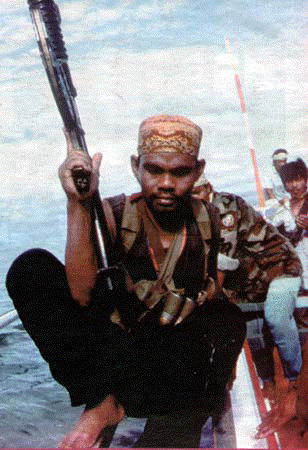
Kudos to Globe journalist Paul Koring for following the case so meticulously and outing the injustice at every turn. Cheers to Gerald Caplan for penning a scathing op-ed without referencing Kafka (everyone else did, including the judge, who likened Abdelrazik to the protagonist in The Trial). Grudging thumbs-up to cherry-picking human-rights guru and Liberal MP Irwin Cotler and celebrated Israeli writer David Grossman for their rebuke of Harper and CSIS.

Excerpts from the Globe's friday blitz of the Abdelrazik story:

"To the very end, the Harper government maintained a consistent attitude toward Abousfian Abdelrazik: mean-spirited, callous, destructive. Instead of announcing that they were willing at long last to allow this innocent Canadian citizen to return home from Sudan, instead of a hint of remorse for his ordeal, instead of explaining how our government intends to help him restore the life they stole from him six years ago, all he and we got was a begrudging eight words from the Minister of Justice."
--Gerald Caplan

"[Maher] Arar got an apology from Prime Minister Stephen Harper and $10-million in compensation for Canada's role in getting him shipped to Syria where he was tortured. In Mr. Abdelrazik's case, the involvement of Canadian governments lasted far longer and was more direct..."
--Paul Koring

"After such a judgment, our government has little moral choice. This case is no longer about legal arguments, if it ever was. It is about a Canadian citizen stranded in Sudan and a government that has shown wrongful resolve in keeping him there."
--Irwin Cotler and David Grossman

"The document, marked 'secret,' shows that the Bush administration knew Sudan was about to release Mr. Abdelrazik from prison in the summer of 2006, and wanted help from Canadian police and anti-terrorism agents to try to charge him."
--Paul Koring

"As well as the Conservative government, a previous Liberal government was involved in denying Mr. Abdelrazik the right to come home. But since the Liberals were in power, two major inquiries, including one into Canada's role in the Maher Arar affair, have criticized Canada for how it deals with torture states. The Conservative government had an obligation to learn something from all that."
--Globe editorial

Here, too, is the Globe's timeline of events in the Abdelrazik affair. Notable is what Conservative Foreign Minister Lawrence Cannon did personally to deny Abdelrazik his rights.

Related Tuque Souq post: Canadian in Khartoum celebrates year of squatting in embassy

Wednesday, May 20, 2009

Mohamed Kohail, in his own words

The Canadian Press released a story late yesterday confirming that Mohamed Kohail, the Canadian citizen on death row in Saudi Arabia, delivered a letter to Prime Minister Stephen Harper via Conservative MP Deepak Obhrai who visited Mohamed Kohail in prison in Jeddah last December.

Extra troubling, aside from the obvious, is that Mr. Obhrai wouldn't confirm whether Mr. Harper even read the letter, leading critics to charge that the Harper administration is trying its best to stay out of this whole affair.

Here is Mohamed Kohail in his own words, to PM Harper:
“Mr. Harper, I have been in jail for two years now. I am imprisoned with hundreds (of) high-profile criminals in Saudi Arabia for a crime that I did not commit... I was tortured to sign a confession... I was misinformed that I would be allowed out of custody the moment I signed it...

“Mr. Harper, I'm 24 now and I don't know how much (more) time I will spend in prison or how much time is actually left on my life... You have ordered your officials to seek clemency for me in Saudi Arabia back in early March (of 2008). However, I have not seen tangible actions made since then... Every time I was assured by the Canadian Embassy (representative) that the government is working secretly on the highest level of officials, the court upholds the death penalty... I was told by the judges that I should not think I would escape the death penalty ... since I am Canadian...

“I've lost my hair, two years of my life and see death coming to me closer every day... I want to come back to Canada to finish my degree — me and the rest of the family — and continue my life as a good citizen... [I beg you to use] every way possible to get me out of this situation.”
Last week, the government of Saudi Arabia decapitated five men--among them Sultan Bin Sulayman Bin Muslim al-Muwallad of Saudi Arabia and ‘Issa bin Muhammad ‘Umar Muhammad of Chad, both of whom were 17 when they committed (admittedly atrocious) crimes--in public executions. This brings the toll to 36 so far this year on Saudi Arabia's state-run chop blocks.

Anyone who thinks Mohamed Kohail has a magic get-out-of-beheading-free card is sorely mistaken. As the Tuque Souq has pointed out here, here and here, the Harper clique is about the only hope that Mohamed Kohail has for justice.

The Harper government spent political capital (and almost certainly a few million loonies, through various channels) to bring home two Canadian diplomats kidnapped in western Africa. Is the cost really that much higher for Mohamed Kohail, or for that matter Abousfian Abdelrazik or Omar Khadr?

Thursday, May 7, 2009

U.S. court still 12 Pirates short of a jury

Would you steal a loaf of bread to feed your starving family? Sure you would. But say your family didn't like bread; they liked boats. Would you steal a boat to feed your starving family?

A Somali mother pleads for her boy, Abduwali Abdukhadir Muse, who was captured by U.S. navy SEALs in their life-imitating-Hollywood rescue of an American freighter captain off the Somali coast.

The boy (who may be as young as 15 or as old as 18; alas, his Pirate's License was lost at sea) will stand trial as an adult. And why not? If you're old enough to hop into a skiff with a crew of emaciated, shoeless desperados, you must be old enough to stand up to a jury of your peers.

Therein, quoth the Bard, lies the rub.

Not only do U.S. prosecutors need to dust off some very old laws pertaining to piracy (see Union Government v. Confederate Pirates, 1861), they need to find a dozen peers of Mr. Muse to render justice.

Apropos of which, the FBI has put out an All-Points-Bulletin for twelve pirates to serve on a jury for the accused.

According to a statement, the shortlist includes: Long John Silver, Captain Hook, Blackbeard, Redbeard, Bluebeard, Sir Francis Drake, Captain Jack Sparrow, Anne Bonny, Mary Read, Grace O'Malley, Captain Morgan, and Mistress Ching.

HOT OFF THE COLD PRESS
Meanwhile, on the home front, Canadian newspapers continue to miss the boat on the pirate story, especially now that Canada's mission in the Gulf of Aden has been extended.

"Canada's Piracy Folly," whined a Winnipeg Free Press editorial, calling for Canada to get tougher on pirates like the Americans and French. "There is no one that the pirates would rather be caught by than Canadians," the article deadpanned.

"Canada's duty on piracy," said a Toronto Star editorial, is to curtail this pussyfooting "catch-and-release" policy and "buff up the handcuffs."

Is it a coincidence that the Star and the Free Press are landlocked papers? Because the one good (albeit brief) angle on the story lately has come from the Halifax Chronicle Herald:

"It needs to be said there is ample evidence of foreign fishing vessels, primarily from the European Union and Asia, having ravaged fish stocks – valuable tuna, in particular – for many years in Somalian waters."

That's a relatively muted version of the whole story: that decades of exploitation of Somali resources, coupled with ruinous attempts by the West (and Ethiopia) at nation-building, have left Somalis with little else to conclude but "a pirate's life for me"; that illegal foreign fishing in Somali waters--the 'other' piracy--has robbed Somalia of more than shoeless pirates like Abduwali Abdukhadir Muse could ever hope to recover.

ONE MORE FREE LINK FOR THE ROAD:
NPR's recent angle on the story: That Somali pirates, hard-up for Swiss bank accounts, have taken to depositing collected ransoms on the sea floor, for later withdrawal.

Tuesday, April 28, 2009

The Dregs of Journalism? Toronto Star serves hot cup of prejudice

At the Tuque Souq, we are obviously very forgiving when it comes to using bad puns in headlines. But we draw the line when bad journalism follows bad pun.

Take Oakland Ross's column from Saturday's Toronto Star: "Logo lands Starbucks in Middle East brew-haha." Mr. Ross picks up on a story that has been around the Middle East blogosphere for weeks and decides to write it with an egregious, if subtle, anti-Arab bias.

At the heart of the matter is Egyptian cleric Safwat Higazi delivering a tirade against the U.S. coffee chain because he thinks its logo resembles the biblical Jewish queen Esther, which obviously--to Higazi--makes Starbucks part of some amorphous Zionist conspiracy.

If the lunacy of this may be self-evident to you, think of how your average Middle Eastern coffee drinker feels about it. The problem is, Oakland Ross didn't bother to find out. It appears he didn't attempt to seek out anyone else authoritative in the Arab world to provide a rational counterclaim to Higazi's remarks.

If Ross were in America capturing conservative televangelist Pat Robertson likening the Starbucks logo to a Jewish conspiracy, do you think he'd be able to publish an article without first seeking out some other Christian leader to remind us that Pat Robertson is a loony.

It is a subtle generalization like Ross's about the Arab world that feeds a greater mischaracterization about Arabs (maybe Israelis too) as twitchy, reactionary, unable to think rationally (and no, I don't think Ross or the Toronto Star are being ironic*).

Take the opening line of the article:

"Sometimes it seems a person can't have a simple cup of coffee in the Middle East without making a political statement."

What this says to a reader is: "Read me, I'm another quirky article about those wacky Arabs always making a fuss over something. And don't worry, I'm not burdened with investigative reporting or journalistic nuance. Instead, I've got a link to YouTube."

Then, he finishes with a tidy insult to the Arabs: your resistance to economic exploitation is futile.

Ladies and gentlemen, your Canadian media! We have a new guest in the Tuque Souq doghouse.

[Thanks for the link, Quinn.]

*Editor's mitigation: The Toronto Star is not a bad paper. It's not a tabloid. It has a circulation of over 440,000, largest in Canada. It wins awards for Investigative Reporting (see: Cribb, Robert). Which is why this piece of claptrap from Ross is all the more vexing.


Blast from the Tuque Souq past: The last time the Toronto Star ran afoul of the Tuque Souq, it was over a terrible crossword-puzzle clue. Read more.

Friday, April 24, 2009

Turkish ambassador flies home for history lesson

Perturbed over Prime Minister Stephen Harper's appearance Tuesday at commemorative vigil for the Armenian genocide of 1915-16, Turkey recalled its ambassador to Canada for 'consultations' in the homeland.

Allegedly Turkey's ambassadors around the world only have one job to do: convince host governments that the thingy with the Armenians wasn't a genocide.

No really. The website of the Embassy of Turkey in Ottawa hosts a section called "Armenian Allegations" whose documents include a 2005 letter from Turkish prime minister Recep Tayyip Erdoğan to his Armenian counterpart, then-president Robert Kocaryan, triumphing a binational "joint group" of historians to once-and-for-all arrive at the truth of the events of 1915-16 in which a reported 1.5 million Armenians were killed in an ethnic cleansing by Turkish nationalists.

There's also a link to an academic publication, "Revisiting the Armenian Genocide," which casts an appropriately academic shadow of doubt on the citadel of 'truth' (either Armenian or Turkish).

And there's a link to a statement (undated) from Turkey's Grand National Assembly exhorting, among other things, that "
Wisdom and logic command Turkey and Armenia not to be afraid of breaking the taboos by working jointly, and to face their history by uncovering all aspects of the human calamity they together experienced."

Turkey has long claimed that the so-called genocide was a rural civil war between rival nationalist factions that resulted in the deaths of hundreds of thousands on both sides at a time when the grip of ethnocentric identity struggle on the people of the Middle East was as firm as Stephen Harper's hair helmet (pictured).

Armenia claims that, well, a million and a half of its people didn't live to see the birth of the short-lived Democratic Republic of Armenia (the fleeting independent state between Ottoman and Soviet hegemony in the Caucasus after World War I).

Today, April 24, is Armenia's official day of commemoration, the anniversary of the arrest of Armenian intellectuals in Istanbul in 1915 which touched off the revolt that led to the genocide (or the not-genocide other thing).

Monday, April 20, 2009

Canadian in Khartoum celebrates year of squatting in embassy

It's been almost a year now since Abousfian Abdelrazik moved into the Canadian embassy in Khartoum. It wasn't because he missed his scrambled eggs with ketchup and peameal bacon. It's because George W. Bush once called him a "turrrist."

On April 28, 2008, Mr. Abdelrazik--a Canadian citizen born in Sudan--took refuge in the embassy because he could not secure a flight home to Canada, and because he was a wee bit tired of the Sudanese security services abusing him. Days before, he'd been given permission to fly only to have that promise broken last-minute by Canada. So he had no other choice but to move in with the ambassador.

Briefly, Mr. Abdelrazik flew from Montreal to Khartoum in August 2003 to visit his ailing mother. Sudanese authorities arrested him on American and Canadian suspicion that he had ties to al-Qaeda because of his prior association with Ahmed Ressam, the so-called Millenium Bomber.

While spending the better part of 3 years imprisoned, interrogated and tortured under the auspices of the FBI, Mr. Abdelrazik's Canadian passport expired (that's his passport photo). He can't get home, although he's been cleared of all accusations (and was never charged in the first place).

He's on the U.S. No-Fly list, so he can't get on a commerical airline that ever operates in the U.S. He found one airline willing to take him, but because he's still on a U.N. al-Qaeda list, Canada won't issue him travel documents, even though he's been cleared by CSIS and the RCMP of any ties to international terrorism.

Ottawa said last month it would push to get him home if Mr. Abdelrazik got himself a ticket, the fare for which (from Khartoum to Montreal) is over $1000. Mr. Abdelrazik is short of cash owing to his insurmountable legal expenses, so a bunch of supporters got together and paid the airfare.

Ottawa balked, invoking a U.N. rule that suggests that in order to fly a named No-Flier through the skies the airplane must receive authorization from every single country whose airspace it occupies along the way. However, Ottawa could apply to the U.N. for an exemption; Britain did it successfully just the other day. But no.

So life goes on at the embassy in Khartoum, where Mr. Abdelrazik gets $100 per month to live in the lobby. (Um, let's see: $100 per month times 12 months = 1 plane ticket home + peameal-bacon breakfasts for everyone in Prime Minister Harper's cabinet. I don't see how anyone loses in this situation.)

Alas, Mr. Abdelrazik remains stranded, sort of like Tom Hanks in that film I never saw because the premise looked entirely preposterous. I guess there's yoke on my face.

Thursday, March 19, 2009

"Between Fatah and Hamas, I choose Canada"

From the first in a series of political cartoons by a Palestinian artist. The strip is part of a Middle East political-cartoon exhibition called "Lighting Lamps" currently touring around the West Bank after visiting Egypt and Jordan:

Man A: "Are you Fatah or Hamas?"

Man B: "I'm Palestinian."

A: "Habibi… don't be clever. We're all Palestinian. Who are you with in the civil war?"

B: "I'm against the civil war."

A: "We're all against it, but it happened…..so who are you with?"

B: "I'm against both."

A: "Don't drive me crazy. You have to choose between Fatah and Hamas."

B: "Between Fatah and Hamas, I choose Canada."

And just for grins, here's another cartoon on the same subject:
Underneath the two straws is written in Arabic (obviously): Hamas and Fatah.

Monday, December 8, 2008

Wolves in sheep's clothing: Election results in Quebec, Israel share same metaphor

Two big elections on Monday are now in the rear-view mirror.

Electors in Quebec served up a cold, hard dish of lait caillé to ADQ leader Mario Dumont, as his party went from official opposition to espèce en voie de disparition roaming the Quebec hinterland.

Meanwhile Jean Charest's Liberals won their bid for majority, helped by a near-record-low voter turnout. For the sovereigntist Parti Québécois, a return to second place after the disastrous 2007 election is actually warm consolation. After all, it's only a matter of time before Charest bolts the provincial Liberal party for a federal Conservative job.

Over in Israel, members of the Likud party went to the polls to vote on that party's list for Israel's upcoming Knesset elections. Benjamin "Count Hawkula" Netanyahu actually seemed like a dove in comparison to some of the right-wing maniacs vying for top slots on the Likud list.

Netanyahu didn't quite get a matzo in the face from the far-right. He still heads the party list and will contend for the office of prime minister in the February national election. But that list also has a lot of pro-settler, anti-peace-process names and young Likudniks eager to make the party relevant again at any cost. Early polls suggest Likud may be the winner in next year's general election.

So in conclusion, a day of electoral victories for hawkish conservatives who occasionally disguise themselves as liberals.

Thursday, December 4, 2008

Prorogation prorogues antirogueing rogues


Prorogue! Well, thus ends the Great Canadian Putsch of '08. Will our edgy politicians survive seven sybaritic weeks of holidays and bring us a Great Canadian Putsch '09: Michael Ignatieff Strikes Back?

Will Gee-Gee Jean publish a tell-all entitled My Rogue: How Stephen Harper won my heart and my reserve power?

Will Pauline Marois take back every nice thing she said about the coalition and put sovereignty back on the péquiste's election agenda?

If a Stéphane Dion falls in a forest with 76 knives in his back, will he make a sound?

All these questions and more will be addressed, just as soon as our government gets back from seven weeks in Bora Bora!

We'll get back to blogging about the Middle East soon.

Revolution Prorogued! Jean falls for Harper's seduction

We are outraged. Not because we were a fan of the fractious coalition of the NDP, Grits and Bloc, nor because Her Excellency failed to use her reserve powers in the most minimal of ways. We are outraged because the revolution is over (suspended, but really over). It's so anti-climactic after 8 days of constitutionally driven suspense. And while our government now gets seven weeks of holidays, the rest of us have to go back to our pre-revolutionary lives.

Sigh, we'll be back with more soon.

The revolution was televised (for 5 minutes); who will the GG listen to?

"Prorogue!" "Dissolve!" "Dismiss!" "Abdicate!" "Save us from ourselves!"

Everybody is trying to tell Her Excellency the Right Honourable Michaëlle Jean what to do. Stephen Harper is making a personal pitch to the Governor General right now to ask her to prorogue parliament. Harper went on TV last night for 5 whole minutes to convince Joe Canadian Sixpack that the Triumvirate of Turpitude - the Liberals, NDP and Bloc - is unpatriotic.

Her Excellency probably got Harper's veiled Bushian message: "You're either with us, or you're with the separatists."

And to no one's surprise, the conservative spin doctors want the media to ask the ridiculous rhetorical questions: "Is Mme Jean a separatist?" "Is she a Liberal?" "Is she really Canadian?"

Talk about pressure.

Meanwhile Stéphane Dion's letter [full-text PDF] to the GG is a bit more impressive than his out-of-focus, awkwardly delivered and comically tardy TV address last night in response to Harper. For Dion's part, he wasn't above playing the partisan card: "In our Canada, the government is accountable for its decisions and actions in Parliament."

NDP leader Jack Layton wants to remind the GG that Harper "is more interested in his job than you and your families' jobs." (See Excellency, even your job is at stake in this crisis.)

Bloc leader Gilles Duceppe said emphatically, "we are finished with [Harper's] government." (Of course, that's actually a standard fill-in-the-blank Bloc quote; replace 'Harper' with 'Dion' or 'Chretien' or 'Martin' or 'Canada' at your leisure.)

And the advice keeps coming.

Former Brian Mulroney chief of staff, ambassador and publishing magnate, Norman Spector says "Let the people decide." (Memo to Norman: the people decided 7 weeks ago; now it's time for the government to make decisions.)

Former Governor General Ed Shreyer says "Nothing should be done to aid and abet the evasion of submitting to the will of Parliament." In other words, the PM wants the GG to rescue him from the mob, and the GG would be constitutionally and morally wrong to do so.

Even those abstract notions of precedent and history are trying to tell the GG what to do.

She's been all ears for days. Now we are.