tuque /tūk/ n Canadian English, var. toque [19th c. Canadian French, from the French toque, from the Basque tauka] 1 A close-fitting knitted cap, often with a long tapering end or tassel or pompom. 2 fig Something quintessentially Canadian.
souq /sūk/ n from the Arabic سوق var. souk 1 An open-air marketplace. 2 fig A central meeting place for the circulation of news and ideas.
Showing posts with label Gaza War 09. Show all posts

Wednesday, February 25, 2009

Egyptian secret police take blogger on joyride

When Egyptian activist and blogger Philip Rizk went to a demonstration to protest the Gaza war, he had no idea that the Egyptian mukhabarat - secret police - were planning to give him a 4-day vacation in jail.

He certainly didn't have a clue that he'd be treated to a high-speed getaway on his way to his incarceration.

But that's what happened. According to a posting on the blog of one of Philip's friends who witnessed these events, the mukhabarat took Philip and his lawyers into a local police station--after he was arrested at the demonstration--while his friends were asked to wait outside. Then:
All hell broke out at 11 p.m. The lawyers rang down to say that Philip had been kidnapped: state security officers had told him that they wanted him for questioning without the lawyers in a room next door. They took him downstairs and put him in a Suzuki microbus which, when it appeared at the police station's exit, we attempted to prevent moving by blocking its path. It forced its way through while state security officers frenziedly threw us out of the way.

Moftases meanwhile had started his car. Droubi and I got in it, Moftases put his foot down and the police attempted to stop us moving by standing in front of it. Moftases drove anyway.

There then followed a car chase, Moftases establishing that if he ever tires of Psychiatry he should consider a second career as a rally-driver. The microbus – whose rear number plate had been obscured by a piece of cloth – moved at great speed through the busy main street before suddenly veering off into a neighbourhood of narrow alleys where it attempted to lose us. They hadn't reckoned on Moftases.

Philip was sitting at the back of the microbus, with roughly four or five men including the driver in front. At one point he turned around, saw us, and smiled. I hope we provided some comfort, however fleeting.

This – extreme speed, dangerous overtaking, sharp turns - went on for about 45 minutes. I don't mean to make it sound exciting. It wasn't. It was sickeningly absurd and unglamorous (a Suzuki microbus for God's sake), frightening, dangerous, and I needed the toilet throughout.

After about half an hour it turned around and went back the way it came. Playing with us, we thought.

It turned out that they had been waiting for a police general who had been at the police station to get himself and his assistants to a police checkpoint building where they extended barriers across the road. We were done for: the microbus – and Philip – disappeared into the night.
Philip was held in jail, blindfolded, without charge for more than 4 days before he was quietly released. He says he was not tortured, only interrogated repeatedly. He was accused of being both a Hamas spy and an Israeli spy.

While he was in detention, the mukhabarat broke into his home and seized his personal documents, cameras, computers, even the passwords to his blog and email accounts.

He denies enjoying the high-speed chase.

POSTSCRIPT
There are more than 18,000 political prisoners in Egypt, including many young activists/bloggers. One is Dia Eddin Gad, who was also swept away by the mukhabarat while protesting the assault on Gaza. His whereabouts are unknown. His blog - Sawt ghadeb ("Angry Voice") - has not been updated since before he was kidnapped.

Tuesday, January 27, 2009

Hamas to Abbas: Which side are you on?

As new/old U.S. Middle East envoy George Mitchell embarks on his Comfy Chair tour of friendly Middle Eastern capitals -- hoping to inaugurate President Obama's peace push -- progress is being attempted on the Hamas-Israel truce front.

Hamas has reportedly offered a one-year truce, asking in return that Israel re-open all of Gaza's border crossings and allow Turkey to play a major role in international monitoring in the Strip. Hamas also wants/plans to take credit for all of the rebuilding in Gaza.

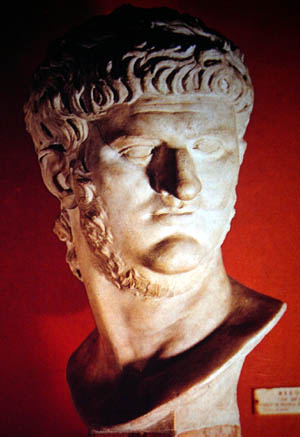
And Hamas also has a stern warning to its political rival, the PA and Prez Mahmoud Abbas: you're either with us, or your with Israel. Abu Mazen hasn't exactly come out of this latest conflict looking like Mandela. And after cracking down on Palestinian freedom of expression in the West Bank while Gaza burned and suffered, the PA increasingly looks weak, desperate, tyrannical and scared. Abbas is a fiddle away from seeing Nero's mug in his own mirror.

The titular head of the Palestinian nation has been feebly working on the peace process with Israel and the U.S., efforts that to Hamas's eyes culminated in Israel's bombardment and invasion of Gaza, a conflict the opining on which Abbas was largely absent. So Hamas wants to know: Hey Mahmoud, which side are you on?

(By the way, Abbas's term as President officially ended on January 9. Now ineptitude is not his only problem; his legitimacy is now officially in question. This won't be lost on his interlocuters when Hamas and the PA meet in Egypt next month for reconciliation talks.)

Tuesday, January 20, 2009

Obama sworn in as President of Gaza

Three things are evident in the editorial coverage of the Israel/Hamas ceasefire:

1) There is undeniable innuendo that the glory of Obama's inauguration caused the tanks and rockets to fall silent; this was necessary so that the entire world could watch the Bush-to-Obama transformation unfettered.

2) There continues to be this absurd insinuation that Hamas is a multi-headed beast with a frail body; that if you chop off the heads (Yassin, Rantisi, Siam... someday Zahhar, Haniyeh, Meshal) that the body will fall over and decay into humus from which will rise the body of a docile farm animal agreeable to Western palates.

3) One shouldn't drink hot coffee while reading the National Post; there's a dangerous potential to burn one's nasal passages.

In the Toronto Star, Monday's editorial painted a monochrome portrait of destruction/relief in Gaza, then panned to Obama's side of the court with a plea that the new prez bring his change to the peace process. But then, columnist Martin Regg Cohn urged Obama to direct the peace process status quo ante. Well then, good thing there's another Clinton on the field.

The Globe and Mail's Friday editorial was the cause of some chortling at the Tuque Souq; Hamas, it said, should accept the inevitability of defeat, in perpetuity, forever. Unfortunately, the very reason that Hamas now sits before the typewriter of the Palestinian national narrative is because it won't accept defeat. And this, in a perversely cyclical way, is the reason it picks a fight with such an unbeatable military force. Recall Hamas's campaign slogan from 2006: "One hand builds, the other resists." There will be a lot of building to do in Gaza now.

An op-ed in Monday's Globe said that among the victories that Israel can take from this war are a) that now Israel in unquestionably militarily superior to Hamas; and b) that now it is revealed that Hamas's promises and proclamations are empty rhetoric. 'Duh' journalism at its finest.

The Montreal Gazette parsed the "hate-mongers" amongst the more legitimate protesters, but over at the National Post, well, now it's time to laugh:
“Many [supporters of the Palestinian side] were the genuinely good-hearted college sophomores, possessing naiveté and Che Guevara T-shirts, claiming to “understand” the “root causes” of suicide bombers, while still regretting their toll on humanity...

In Gaza today, with no real 'occupation' to resist, and Hamas’ organized attacks against Israel, those supporting the Palestinian side have a much harder time arguing ethical equivalence...

Relatively moderate voices, and the let's-get-along crowd, with less to say, and probably less motivation to say it, are crowded out by those who loudly root against Israel as a general rule: postmodernists, hard-edge Islamists and old fashioned anti-Semites.”
Postmodernists?

Monday, January 19, 2009

From underneath the rubble of Gaza

“From talking to many people, I can say that Palestinians in Gaza are against the continuation of fighting. They are relieved it is over. Hamas has sensed that; therefore, Hamas political leaders have decided to abide by the truce. From talking to Hamas senior leaders, one can sense their interest in the truce not only because of the public pressure but also because they need to succeed in governance.

“Regarding the firing of the rockets, there is split of opinion. Those supporting Hamas view the Qassam rockets as a method to put pressure on Israel to ease their lives. One woman said, 'It’s symbolic. With firing the Qassam rockets, we want the world to notice our issue of occupation,' one Hamas member said. 'The goal is to try to create a balance in fear.' On the other hand, there is a stronger voice that is against the rockets. Their logic is: why invite an Israeli retaliation? It will be interesting to see if that voice will become louder in the coming stage. It’s too early to come out with a conclusion regarding Hamas’s popularity. Definitely there are those who are disappointed at Hamas for driving them into this stage, but we can’t ignore those who are blaming Israel.”

-- Taghreed El-Khodary, New York Times Gaza correspondent, in an interview about her time in the Strip during the war.

Sunday, January 18, 2009

Stop and reload?

The morning after the ceasefire, which is Israel's, as Gazans are walking the streets and surveying the damage of 22 days of ceaseless bombardment which has killed at least 1300, including 410 children, the Middle East press is weighing the possibilities of conflict resolution:

A Ha'aretz editorial warns that a long-term solution has to consider the interests and fears of Egypt as well as of the people of Gaza. Yedioth Ahronot spells out exactly why Egypt can't be counted upon to be part of the solution. The Jerusalem Post tells all Israelis to continue living in fear.

Asharq alawsat exposes the hypocrasy of the Doha Arab summit; the Daily Star agrees. Al-Ahram says that Gaza is Egypt's nightmare it cannot ignore. Al-Hayat argues that a political solution must find a way to reward Palestinians for their steadfastness.

Saturday, January 17, 2009

"Who Blamed Who" tops the charts in the Middle East during Gaza War

Now that a cease-fire is in effect in Gaza (or, depending on when you wake up Sunday morning, it could already be over), we can pause and examine the status of the blame game for the war.

Obviously, Israel blamed Hamas, and Hamas blamed Israel.

Gamal Essam el-Din, writing in Al-Ahram weekly [ENGLISH], had an enviable perch inside the recent meeting of Arab delegations in Cairo, from which he observed the cacaphony of Who blamed Whom for What When in collaboration with Whom against Whom and How? Libya blamed Egypt, which blamed Hamas, and also Israel, and then Iran, while Syria got blamed for something, and Saudi Arabia, and Hezbollah, and then someone suggested kicking Egypt out of the Arab League.

In Israel, nationalist parties Yisrael Beitenu and National Union accused Israel's Arab parliamentarians of sympathizing with Hamas, blaming them for inflaming the conflict through anti-patriotic rhetoric. The result: Israel's Election Commission has banned Arab political parties from participation in next month's national election.

A group of British Jews blamed Israel, while the British Arabic press blamed Hamas. Syria was blamed for using Hamas as a pawn in its interminable chess match with Israel. The NY Times reported that Israelis blame everyone in the world but themselves.

People in Auckland blamed America and threw shoes at the U.S. consulate.

And in a couple of days (or hours), Israel will probably blame Hamas for violating the conditions of its unilateral ceasefire. And Hamas will again blame Israel for being Israel.

Thursday, January 15, 2009

Nasrallah: Israel has naughty plans for Hamas, Hezbollah


Some double entendre going on in the translation of Sheikh Hassan Nasrallah's latest speech about the Gaza war. I won't ruin it for you (it comes at about the 2:00 mark of the video), but it suffices to say that the perfectly good verb that Nasrallah uses with respect to what Israel hopes to do with Hamas and Hezbollah -- نقل which means 'to displace' or 'transfer,' 'translocate,' -- is translated a bit more creatively by the subtitlist.

Tuesday, January 6, 2009

Canadian media use human shields as shields against humanity

Thumbing the pages of Canada's major national dailies, it's not hard to discern that the editors prefer Israel's acknowledged defence to Hamas' accused offence on the topic of the current bloody brouhaha going on in Gaza.
Canada's largest-circulation daily, the Toronto Star, said on December 30 that "Israel is justified, but at what cost?" Expounding, the editorial sought a nuanced perspective:
"First let it be said that it is understandable why Israeli forces are attacking Gaza... It can be argued, of course, that the Israeli counterattack is disproportionate. Hundreds of Palestinians have been killed in the past few days, while only two Israelis have died in the latest rocket attacks."
Nuanced is the article, though not the difference between "Let it be said..." and "It can be argued..." And then...
"But that just points to the difficulty of mounting an attack against a covert force using civilians as shields."
A sweeping grab of all Gazan civilians as human shields? So much for nuance.

A few days later, on January 3, the Star sobered up:
"[M]oderate Palestinians are becoming radicalized by the lopsided war. This past week 430 Gazans, including women and children, were reported killed and 2,200 hurt; four Israelis have died."
The Star then argued that Canada should offer to send monitors to Gaza as part of a UN initiative. But the Star knows what happened to the last Canadian soldier stationed between Israel and its adversary.

The Globe and Mail's January 6 editorial was less than "measured"...
"The ground invasion of the Gaza Strip, to prevent the firing of rockets into Israel, is consistent with the Israeli government's prudent, limited war aims... If the Israel Defence Forces have to return again and again, to suppress new supplies of such rockets, so be it."
... and practically offered tactical advice to the IDF...
"The seizure of a few apartment buildings on [Gaza] city's outskirts, however, makes sense to provide the IDF with good vantage points... The priority is to root out as many rocket-launching positions and mobile militia squads as possible."
... and compared - very oddly - Israel's siege of Gaza with that of Stalingrad:
"...avoiding the horrific precedents of Stalingrad in 1942 and Manila in 1945."
Um, who besieged Stalingrad again?

A rather feeble January 3 editorial in the Globe mentioned that,
"... the broad Israeli public is sick to death of eight years of rocket attacks from Gaza."
... which is certainly true, but they neglected to mention anything about the broad Gaza Strip public and its metaphorical health vis-a-vis 42 years of Israeli oppression. The editorial concluded with the meek line,
"International pressure is needed to persuade both sides to accept an exit plan before an already deadly conflict takes a turn for the worse."
It's worse.

The National Post, which has opined on the recent conflict with the help of notorious Israel apologist Daniel Pipes, went to press on January 6 with an editorial that unambiguously called Israel "the victim" and further summed up Gaza's entire civilian population as human shields...
"Never mind that Israel's campaign in Gaza has been humane by military standards -- surgically killing hundreds of Hamas gunmen yet only a few dozen of their human shields."
"Humane" is a matter of opinion, but civilian deaths are a matter of fact lost so often by the press during the past week. At the time of this editorial, more than one hundred Palestinian civilians were confirmed killed.

Now it's up well over 200.

[Editor's note: Don't think for a sec that we condone or defend the deliberate use of human shields by combatants, nor willy-nilly apologize for the belligerence of Hamas. But the fact of the matter is that the Gaza Strip is not exactly the Ardennes Forest. Humans live everywhere in the Gaza Strip, densely. And while we would prefer to see neither side engage in armed conflict, and further deplore the deliberate use of human shields (such as Israel did during the siege of Jenin Refugee Camp in 2002), it is undeniable that residency in the Gaza Strip does not ipso facto make one a "human shield." There are 1.7 million residents in the Gaza Strip. We acknowledge that, just as we acknowledge that war ain't pretty and all people under oppression have a right to defend themselves, be they residents of a town under rocket fire or residents of a Strip under bombardment. We humbly argue that the mainstream media should acknowledge likewise.]

Israeli-Palestinian Cyberwar releases version 2.0

According to a story from ABC News, within 48 hours of the start of Israel's bombing campaign against Gaza, "anti-Israeli hackers based in Turkey, Iran and elsewhere violated the security of more than 300 [Israeli] Web sites and replaced the existing content with their own messages and images...

"[A]n American cybercrimes expert said thousands of Israeli and American Web sites have been defaced by radical Muslim hackers. A broad spectrum of sites, including those belonging to small businesses, a media company and a cargo airline, have been hacked into and plastered with anti-Israeli and anti-American messages."

There are reports of anti-Israel hacks originating in Turkey, Morocco, Iran, Europe, and other places, as well as from the Palestinian territories.

Israeli hackers are engaging their cyber arms, too. One group recently hacked into to the website of the Izz al-Din al-Qassam brigades - Hamas' military wing - and uploaded the Israeli national anthem.

Apparently Hamas is even offering rewards to hackers who come up with innovative ways to strike Israeli targets. Palestinian Islamic Jihad has its own cyber-warfare brigade.

According to one research paper from the Military Review (a U.S. Army journal), the Israeli-Palestinian cyberwar dates back to 1999. Then in 2000, just after the second Intifada began:
Israeli teenage hackers created a website to jam Hezbollah and Hamas websites in Lebanon. The teenagers launched a sustained denial of service attack that effectively jammed six websites of the Hezbollah and Hamas organizations in Lebanon and of the Palestinian National Authority. This seemingly minor website attack sparked a cyberwar that quickly escalated into an international incident. Palestinian and other supporting Islamic organizations called for a cyber Holy War, also called a cyber-Jihad or e-Jihad. Soon after, hackers struck three high-profile Israeli sites belonging to the Israeli Parliament (the Knesset), the Ministry of Foreign Affairs, and an Israeli Defense Force information site. Later, hackers also hit the Israeli Prime Minster's Office, the Bank of Israel, and the Tel Aviv Stock Exchange. [More]
And well, things have only gotten more sophisticated since then.

Monday, January 5, 2009

Gaza War: "Life must go on..."


If you haven't seen it, check out this blog called "Life must go on in Gaza and Sderot."

It's written by two men, one called "Hope Man" who lives in the Israeli town of Sderot, just east of the border with the Gaza Strip. The other, "Peace Man," lives in Gaza City.

They started their blog as electronic acquaintances wanting to provide 2 sides of the story of their perspective on the Israeli-Palestinian conflict. Sderot is the town in greatest danger of being struck by Hamas' homemade missiles, and Gaza is, well, Gaza.

Obviously this blog has gotten even more insightful in the past week or so.

Tuesday, December 30, 2008

That elephant in the bathtub? He speaks Persian

Q: How can you tell if there's an elephant in the bathtub with you?
A: By the smell of peanuts on his breath.

It's starting to smell like peanuts in the Middle East tub. So who's the elephant?

Israel's brutal attacks on Gaza have prompted some in the Arab media to start looking around the room.

Writing in al-Hayat, Mohammad Salah points his finger in the general direction of the elephant, arguing that ever since Hamas went down the road of dividing Palestine, the result has not been to the gain of only Israel:
"[When] Hamas took over the Gaza Strip... things became even worse; Palestinian disunity became a reality and there was no longer one Palestine, but two... Whoever hopes for the Palestinians to re-unite or rally behind a single leadership for the Palestinian people in its confrontation with Israel, peacefully or militarily, is deluded... Hamas will [not] relinquish its control over Gaza under any conditions, the PA has [no] authority to return the Gaza Strip to the rest of what remains of Palestine. Moreover, regional parties with influence over the Palestinian cause have not united behind the PA or Hamas; rather, they are divided between the two."
Who are these "regional parties"?

Jihad al-Khazen, sometimes a Hamas supporter, goes on:
"I still do not understand the reasons why Hamas - being the government - turned on itself and created an emirate for the Muslim Brotherhood in the Strip instead of trying to free the whole land then see what kind of rule people wanted in an election. Politics is not worthy of its name if it is not the politics of the possible. Hamas' policy in Gaza is suicidal."
The Arab world is becoming more divided, writes Jonathan Wright in the Egyptian Gazette, making eye contact with the elephant in the room:
"There is an Iranian plan, with Hamas and some of the Muslim Brotherhood, to stir up trouble in Palestine and Egypt. The Muslim Brotherhood, [Egypt's] banned-yet-influential group with one fifth of the seats in parliament, is in close alliance with Hamas, which began as a Brotherhood offshoot."
As usual, asharq alawsat editor-in-chief Tariq Almohayed draws a complete picture, pointing out that Hezbollah leader Sheikh Hassan Nasrallah spent half his recent speech - ostensibly delivered to criticize the Israeli assault on Gaza - inciting Egyptians to turn against their government, and the other half of his speech stirring up the usual bitterness dividing Lebanon.

Comparing the course that Hamas has taken with that of Hezbollah, Almohayed suggests:
"Shouldn’t Hamas turn away from Iranian assistance to strengthen it when all this does is torture the people of Gaza and subject them to brutal Israeli force?"
What is the emerging trend here? Let's go down the list of current events:
  • Lebanon: divided (Hezbollah with Syrian elements vs nationalist factions; and factions vs factions as a result)
  • Iraq: divided (ethnic and religious factions vs each other)
  • Palestine: divided (Hamas vs Fatah vs common sense and democratization)
Who gains with this kind of division in the Arab world? Israel of course. But just Israel?

What we're increasingly seeing from the Arab media is portrayal of the fact that Iranian support of the Muslim Brotherhood, of Hezbollah, of Hamas, of certain Shi'ite groups in Iraq, is ripping up the region.

And ironically, Israel's bloodletting only helps Iran achieve its goal of permanent destabilization. Because, of course, Israel has the same objective. The Arab media is quite practised at criticizing Israel - justifiably, for the most part - but not at identifying Iran as complicit in, for example, the emerging Israel-Hamas war.

As the scope of the bloody Gaza war becomes clearer, this is changing. That elephant in the bathtub? It's Iran.