tuque /tūk/ n Canadian English, var. toque [19th c. Canadian French, from the French toque, from the Basque tauka] 1 A close-fitting knitted cap, often with a long tapering end or tassel or pompom. 2 fig Something quintessentially Canadian.
souq /sūk/ n from the Arabic سوق var. souk 1 An open-air marketplace. 2 fig A central meeting place for the circulation of news and ideas.
Showing posts with label Womens Issues. Show all posts

Thursday, June 25, 2009

Qaddafi defends a woman's right not to be a man

Today's Arab woman is not an ottoman, echoed one of the messages of Libyan dictator Colonel Muammar Qaddafi on his recent history-making visit to Italy.

The colonel excoriated his fellow Arabs who treat women as "pieces of furniture which you can change when you want, and no one will ask you why you have done it."

This quip, delivered to an audience of more than 1000 Italian women whose audience the Libyan leader requested on his official state visit, earned Qaddafi praise from some Italian women's rights groups, who declined to specify exactly which Arabs they believed the colonel was talking about.

In related news, Qaddafi arrived happily in Rome escorted as usual by his all-female bodyguard corps; it is not known exactly what rights this particular women's group has vis-a-vis the colonel.

"There is no difference between men and women on a human level," Qaddafi said to his audience, before adding an explanatory self-contradiction: "God made men and women, we must respect the differences between the sexes."

Mara Cafagna, a former beauty queen and topless model who now happens to be Italy's Minister of (ahem) Equal Opportunities, was quite taken with Qaddafi's message of women's liberation. Qaddafi's speech is "a strong clear message against the abuse of women," she said.

But other women in Qaddafi's audience were skeptical, noticing that Qaddafi's bodyguards--far from traditional notions of military protocol--spent most of the time serving their boss drinks.

"He really is on a different planet," said one female guest at Qaddafi's event. Natch!

Italian Prime Minister Silvio Berlusconi, himself an assiduous defender of a woman's right to bare arms (et cetera), showered Qaddafi with the kind of attention he usually reserves for 18-year-old models. And as a result all this political canoodling between the two great lovers of women, all Italians should benefit from lower fuel and electricity bills in the near future.

Qaddafi concluded his speech to the gathered audience of Italian women by asking rhetorically, and referencing a policy that is only applied in Saudi Arabia among Arab countries: "Why should these [Arab] women have to apply to the head of state for the right to drive a car?"

The audience, noted a report from the Guardian, applauded politely,

Then Qaddafi lost them when he added: "This is a matter for their husbands or brothers [to] decide."

As the booing and hissing dislodged him from the rest of his speech, a smiling Qaddafi invited everyone present to visit Libya whenever they wanted, and quickly left the stage.

Tuesday, April 7, 2009

Y Chromosome no longer required for Algerian presidential candidates

The ruling Front de Libération Nationale (FLN) will be looking to extend its run of electoral triumph as Algeria votes in a presidential election this Thursday, April 9.

Heading into the campaign season earlier this year, nationwide bated breath greeted President Abdelaziz Bouteflika's long-rumoured decision to seek re-re-election after having served 10 years already at the helm. [That's Bouteflika in an AFP photo at left, gesturing to a crowd to "keep it real."]

Taking a page from Hugo Chavez, Bouteflika deftly navigated through the Athenian murk that is "legislated term limits" and managed to put himself on the ballot for a third term, which he is likely to win. Last time around he won with a mere 85% of the vote.

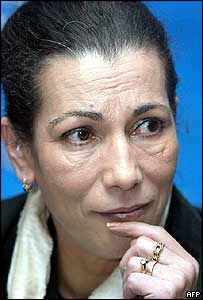
But there are 5 other contenders vying for the podium in Algiers, none of whom is more interesting than Louisa Hanoune, who two days past her 55th birthday is on the ballot for the Trotskyist Algeria Worker's Party trying to become the Arab World's first female leader.

If she does somehow win, her presence will certainly alter the optics of the League of Arab States, whose all-male leaders are pictured together at left during a recent pan-Arab summit. [Note: Bouteflika, if you can't recognize him, is by far the shortest guy in this photo.]

Ms. Hanoune has been taking her populist message for political and economic reform around the country, hosting more than 40 rallies which have attracted especially large crowds of Algerian youth. She wants to reform (i.e. liberate from cronyism) the political-party system and the civil service in Algeria, regulate the emerging private economy, and institute long-overdue land-ownership reforms.

But she probably won't win. Violence has marred this election season, which seems certain to ensure a more carefully orchestrated "free" election by the ruling FLN, as well as a surge in support for the military-backed Bouteflika who seems to many voters like the go-to guy for keeping Algeria out of further civil war.

Still, Ms. Hanoune has a growing popularity and a strong, unifying leftist-nationalist agenda (which attracts that emerging demographic in Algeria that is both tired of the FLN and ever wary of the Islamists). One can hope.

[Update Apr 10: Bouteflika wins 3rd term with 90% of vote.]

Monday, November 24, 2008

"Historic" Egypt appoints first woman mayor

With that most overused and underwhelming of clichés, al-Arabiya reported that Eva Habil Kerolos has "made history" by becoming the first woman mayor in Egypt.

Ms. Kerolos, a Coptic Christian, was appointed mayor of the village of Kambuha, located along the Nile in central Egypt near the city of Asyut. Her father was once mayor, too - for 40 years.

A member of Egypt's ruling al-Watani party and long an advocate of women's issues, especially literacy, she has pledged to improve her village's infrastructure and the environment of the countryside.

It's a historic moment for Egypt, but Ms. Kerolos is not the first female executive in the modern Arab Middle East. Palestine has two. Fathiya Barghouti Rheime was the first woman mayor of a Palestinian municipality, chosen mayor of the village of Beit Rima in January 2005. Her win helped pave the way for Janet Mikhail, elected mayor of Ramallah later that same year. Ms. Mikhail is the first woman mayor of a major city in the Middle East. Lebanon has three woman mayors, and Jordan one.