
Showing posts with label Democracy. Show all posts
Showing posts with label Democracy. Show all posts
Sunday, December 13, 2009
Ladies and Gentlemen, the P-P-Prime Minister of L-L-Lebanon
What's got Sa'ad al-Hariri all sweaty under the collar? The newly sworn in Lebanese prime minister delivered a speech to parliament last week during which he choked on more words than Peter MacKay at a torture tribunal.
Doing his best impersonation of Ken from A Fish Called Wanda, Mr. al-Hariri stumbled through his address, finally reaching the point where the whole chamber was splitting at the seams as the prime minister self-effacingly laughed off his own awkwardness. Finally, parliamentary speaker Nabih Berri came to his aid and finished the speech.
Why was the PM so nervous that he could not deliver a simple speech with the text right there in his hand? Is it that tough to run Lebanon? Oh right, it is.
Related post: Syria to open embassy in Beirut, BBQ planned for opening night


Friday, November 6, 2009
Palestinian president to retire (gasp) while still breathing
 He didn't do much for Palestine. But at least he always looked thin next to Ariel Sharon.
This week Palestinian president Mahmoud Abbas decreed that elections for his own office will take place this coming January, and further he announced that he will not seek re-election.
The 74-year-old Abbas, also known as Abu Mazen, made the announcement speaking to reporters in English, because the phrase "will not seek re-election" is believed not to exist in Arabic.
Abbas was elected president on January 9, 2005, two months after the death of Yasser Arafat. Though his term officially expired earlier this year he granted himself a one-year extension so that the presidential election and term could be brought into line with parliamentary elections and terms, which (all things considered) is not really a bad excuse.
However, Abbas jumping the presidential ship before his death is a bold move, in the context of the Arab world.
 Currently, the presidents/kings/emirs/Qaddafis of Morocco, Algeria, Libya, Tunisia, Sudan, Egypt, Jordan, Syria, Qatar, Bahrain, Oman, Yemen, the United Arab Emirates and Djibouti have been in "office" a combined 254 years (an average of 18 years per man; Sultan Qaboos, pictured, of Oman has been throning it up since 1970).
Only the rulers of Kuwait*, Saudi Arabia**, Iraq***, Lebanon****, Mauritania***** and Comoros****** have taken the helm of their respective nations since Abbas won in 2005.
* Current emir succeeded his brother who succeeded his father.
** Current king succeeded his brother who succeeded his father.
*** Most recent elections in 2005 may have been held under duress.
**** Elections were held in June, but the winner has not been sworn into office yet.
***** Current leader overthrew democratically elected former leader in a 2008 coup.
****** Held a successful election in 2006 which featured a peaceful transfer of power from one party to another.
To be sure, Abbas doesn't have much of a record to stand on. His party lost parliamentary elections to rival Hamas, after which he oversaw a mini civil war that resulted in Hamas taking over the Gaza Strip. He failed to achieve a badly needed unity government, barely whimpered as Israel erected settlement after settlement expansion, and barely blinked at the worst social catastrophe in Palestine since 1967.
And recently he was accused of treason for not backing the Goldstone Report [PDF], which we now know was partly because of his ties to a mobile phone company whose prospective millions would've been threatened if certain Palestinian business ties with Israel were severed because of political unrest.

Still, for Mahmoud Abbas to call it quits after a measly 5 years in office is, well, unpresidented. Especially since he hasn't groomed his son and/or brother to succeed him. Right now his Fatah party has no clear Number 2.
Does this mean we're about to witness a truly open and transparent multiparty democratic election process that properly represents and reflects the political diversity of a nation of people who don't even have their own country because their land is enduring a sixty-one-year military occupation?
Or will this guy just take over?

Sunday, June 21, 2009
How to Twitter a Free Iran
 As the election protests in Iran enter their second week, authorities are cracking down on real journalists and (ahem) citizen journalists (bloggers, facebookians, twitterese, flikrish) alike who are disseminating the information that allows the clandestine organization of the protests to continue.
Most of you out there in Twitterland have already been told to set your location setting to Tehran and your time zone to GMT +3:30 (Iranian time); Iranian authorities are tracking cyberdissent by these and other measures, so as the theory goes, the more non-Iranians that tweet in Iranian disguise, the fewer actual Iranian agitators the Ayatollah will be able to track down, shut down, and shut up.
From a posting on #iranelections cyberwar guide for beginners,* here are the ways in which you can help free Iran from your own home, office or Starbucks La-Z-Boy:
- Do NOT publicise proxy IP’s over twitter, and especially not using the #iranelection hashtag. Security forces are monitoring this hashtag, and the moment they identify a proxy IP they will block it in Iran. If you are creating new proxies for the Iranian bloggers, DM them to @stopAhmadi or @iran09 and they will distributed them discretely to bloggers in Iran.
- Hashtags, the only two legitimate hashtags being used by bloggers in Iran are #iranelection and #gr88, other hashtag ideas run the risk of diluting the conversation.
- Keep your bull$hit filter up! Security forces are now setting up twitter accounts to spread disinformation by posing as Iranian protesters. Please don’t retweet impetuosly, try to confirm information with reliable sources before retweeting. The legitimate sources are not hard to find and follow.
- Help cover the bloggers: change your twitter settings so that your location is TEHRAN and your time zone is GMT +3.30. Security forces are hunting for bloggers using location and timezone searches. If we all become ‘Iranians’ it becomes much harder to find them.
- Don’t blow their cover! If you discover a genuine source, please don’t publicise their name or location on a website. These bloggers are in REAL danger. Spread the word discretely through your own networks but don’t signpost them to the security forces. People are dying there, for real, please keep that in mind.
- Denial of Service attacks. If you don’t know what you are doing, stay out of this game. Only target those sites the legitimate Iranian bloggers are designating. Be aware that these attacks can have detrimental effects to the network the protesters are relying on. Keep monitoring their traffic to note when you should turn the taps on or off.
- Do spread the (legitimate) word, it works! When the bloggers asked for twitter maintenance to be postponed using the #nomaintenance tag, it had the desired effect. As long as we spread good information, provide moral support to the protesters, and take our lead from the legitimate bloggers, we can make a constructive contribution.
*The instructions also come with a warning: "Please remember that this is about the future of the Iranian people, while it might be exciting to get caught up in the flow of participating in a new meme, do not lose sight of what this is really about."
In other words, please don't meme and run. The Twitter Revolution needs you!Friday, June 12, 2009
Ayatollocracy Votes Today
 Iran's presidential elections are today!
Defending champion Mahmoud Ahmadinejad is the slight favourite to repeat, after running what has been called a "dirty" campaign against his rivals, and principally his main challenger, former Prime Minister Mir Hossein Musavi.
Mr. Musavi is seen as the progressive candidate, supported by former president Mohammed Khatami, who withdrew from the race in March after a brief flirtation with another run at the top.
One of the biggest story lines of the campaign is whether Mr. Musavi could separate himself from Mehdi Karrubi, former Speaker of Parliament and also considered a progressive candidate. Iranian moderates and progressives fear a vote-split between the two, which of course would favour Mr. Ahmadinejad.
The fourth and final approved candidate, Mohsen Rezai, former chief of Iran's Revolutionary Guards--the elite state police unit--is considered a long shot and who is still a wanted man in Argentina for his alleged role in the 1994 bombing of a Jewish community centre.
Women in cities, students and ethnic minorities--all of whom tend to vote more progressive than the national average--figure to play a prominent role in today's outcome.
The two front-runners have sparred mainly over domestic and economic policies. They agree very generally on Iran's right to nuclear technology, although Mr. Musavi has accused Mr. Ahmadinejad of turning Iran into a pariah state over the issue. Both agree that the West's attitude toward Iran must change, but the progressive candidate has tacitly argued for dialogue with the Obama administration.
An unbelievably exhaustive analysis of the candidates is here. Read on, and follow the results as the day continues. Big day for Iran and the world.
[Left to right in the photograph: Rezai, Ahmadinejad, Karrubi, Musavi]
Tuesday, June 9, 2009
Lebanon votes March 14 on June 7, McFalafel expansion safe
 Lebanon's March 14 movement defeated the March 8 movement by six days, er... points, in Sunday's elections, ushering in the country's first ever peaceful transition from status quo ante to status quo.
Somewhere in the shadows, reclusive Hezbollah chief Hassan Nasrallah breathes a sigh of relief. No wait, there he is giving a press conference.
A contrite Sheikh Nasrallah accepted the defeat of his majority Shi'ite party Amal--which is aligned with other parties including that of pro-Syrian Christian general Michel Aoun in a bloc known as the March 8 movement--in the Lebanese parliamentary elections. The combined March 8 bloc took only 57 seats out of 128, a surprisingly low total.
 The remaining 71 seats were scooped up by the dozen parties that comprise the March 14 movement led by Saad al-Hariri, son of slain former Prime Minister Rafik al-Hariri, whose bloc is decidedly pro-Western, patently anti-Syrian, and ambivalently pro-McFalafel.
Analysts suggest that the Lebanese swung decisively to March 14 out of fear that Hezbollah would set up an Islamic Republic if victorious. More likely, Hezbollah never really wanted to lead anyhow.
After all, leadership means making decisions, being accountable, forging compromises, and a whole host of other things that lead inevitably to declining poll numbers, restless and implacable constituents, scandal, and finally death by electoral stampede in the next vote.
Why the hell would Hezbollah want that, especially as long as they get to keep all their guns whether they win or lose?
McFALAFEL? SERIOUSLY?
 In fact wholly unrelated to the Lebanese elections, the McFalafel is a sandwich first introduced in Egyptian McDonald's restaurants in 2000; it has since spread to McDonald's in Lebanon and Israel.
McFalafel is also the name of a new fast-food joint that opened recently in a Hasty Market convenience store in Toronto's Islington Village. Dundas and Islington is a wee bit far from the Tuque Souq's home, especially since we have Ali Baba's just a block away. Anybody out there try the new McFalafel yet?
Tuesday, May 12, 2009
Aloha(locaust): 12-year-old candidate to offer Hawai'i to Jews
 He's only 12 years old, but Kourosh Mozouni already knows how to find Hawai'i on a map, and he's damn confident that, if elected Iran's next president, he'll be able to convince all Israelis to move there.
The precocious pre-teen is the 171st and littlest candidate to officially register for Iran's upcoming presidential election, scheduled for June 12. He unveiled his campaign platform at a rally in Tehran yesterday, beaming to an adoring crowd and confidently asserting that Iran's "mothers, children and young adults will vote for me."
Mr. Mozouni's ambitious agenda includes banning video games ("they encourage an indolent comportment in Iran's proud citizenry"); giving mothers the right to work ("verily a mother's hand offers strength as her enduring love engenders wisdom"); and free refrigerator-repair education for all ("You all have refrigerators at home but do you know the different parts of it?").
And, once elected to Iran's highest elected office, the lil' tyke plans a summit with his American counterpart, the objective of which shall be the successful and fair-market-value purchase of the Hawai'ian islands, which Mr. Mozouni will offer to the Jews as a new homeland.
 According to the campaign, the original tribes of Israel will be apportioned to the Hawai'ian islands. The Levites, in keeping with Biblical tradition, do not share in the apportionment of the land.
Kourosh Mozouni seems to have some support amongst the masses, but Iran's secretive ayatollocracy still holds ultimate sway; the supreme Guardian Council vets all presidential hopefuls before the election, and the wee Kourosh is not expected to make the final cut.
Monday, April 27, 2009
Yemeni Elections: Horse retakes traditional spot ahead of Cart
 "One man, one vote" has been a key principle of democracy since the invention of high-school civics class. (And then, about a hundred years ago when women were invented, the principle became "one person, one vote.")
In Yemen, however, due in no part to hardships in translation, the principle in recent years has been "one spot, one vote." As in, the number of spots you can claim as yours equals the number of votes you get. Example: a soldier who has a place of birth, a place of residence (family home), and a place of other residence (military base) in theory gets 3 votes, according to Yemen's highly unregulated electoral system.
In a nutshell, this is why the parliamentary elections scheduled for today have been postponed for 2 years. Two years! At the demand of the opposition bloc! When was the last time you heard of an opposition party demanding that the current government maintain its grip on power for another two years?
The opposition coalition--a mishmash of die-hard pan-Arabists, Islamists and socialists which calls itself the Joint Meeting Parties (JMP)--threatened to boycott the elections if the ruling General People's Congress (GPC) party of President Ali Abdullah Saleh did not institute electoral reforms to safeguard a free and transparent vote. The EU threatened to pull its election monitors if the JMP carried out its boycott. The GPC decided to postpone the polls to save face, and the JMP declared it would take two years of hard negotiations before Yemen would be ready to turn the corner of democratization.
 Not on the ballot: Whether the old city of Sana'a is the most beautiful in the world. (National Geographic Photo)
What's two more years to the current prez? Mr. Saleh has been at the helm for 31 years: from 1978-1990 as president of the Yemen Arab Republic (a.k.a. North Yemen); and from 1990-present as president of the united Republic of Yemen. Along the way, he's won a slew of dubious elections with very one-sided results.
It's not just the "one spot, one vote" hijinx that rendered Yemen ill-prepared for a free vote today. Negotiations between the JMP and the GPC have included the former's proposals for (and the latter's resistance to) a non-partisan or bipartisan election commission, a system of proportional representation that preferences policies and platforms over demagoguery, and security measures to ensure unfettered access to the polls for every Yemeni citizen.
Come to think of it, maybe two years isn't such a far-fetched estimate. Heck, even Canada could use some of these reforms.
Tuesday, April 7, 2009
Y Chromosome no longer required for Algerian presidential candidates
 The ruling Front de Libération Nationale (FLN) will be looking to extend its run of electoral triumph as Algeria votes in a presidential election this Thursday, April 9.
Heading into the campaign season earlier this year, nationwide bated breath greeted President Abdelaziz Bouteflika's long-rumoured decision to seek re-re-election after having served 10 years already at the helm. [That's Bouteflika in an AFP photo at left, gesturing to a crowd to "keep it real."]
Taking a page from Hugo Chavez, Bouteflika deftly navigated through the Athenian murk that is "legislated term limits" and managed to put himself on the ballot for a third term, which he is likely to win. Last time around he won with a mere 85% of the vote.
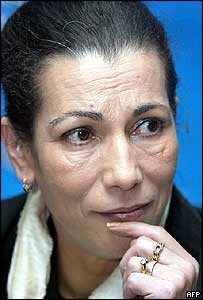 But there are 5 other contenders vying for the podium in Algiers, none of whom is more interesting than Louisa Hanoune, who two days past her 55th birthday is on the ballot for the Trotskyist Algeria Worker's Party trying to become the Arab World's first female leader.
 If she does somehow win, her presence will certainly alter the optics of the League of Arab States, whose all-male leaders are pictured together at left during a recent pan-Arab summit. [Note: Bouteflika, if you can't recognize him, is by far the shortest guy in this photo.]
Ms. Hanoune has been taking her populist message for political and economic reform around the country, hosting more than 40 rallies which have attracted especially large crowds of Algerian youth. She wants to reform (i.e. liberate from cronyism) the political-party system and the civil service in Algeria, regulate the emerging private economy, and institute long-overdue land-ownership reforms.
But she probably won't win. Violence has marred this election season, which seems certain to ensure a more carefully orchestrated "free" election by the ruling FLN, as well as a surge in support for the military-backed Bouteflika who seems to many voters like the go-to guy for keeping Algeria out of further civil war.
Still, Ms. Hanoune has a growing popularity and a strong, unifying leftist-nationalist agenda (which attracts that emerging demographic in Algeria that is both tired of the FLN and ever wary of the Islamists). One can hope.
[Update Apr 10: Bouteflika wins 3rd term with 90% of vote.]
Tuesday, March 17, 2009
Kuwaiti Prime Minister plays "tag" with self over and over again
 Kuwaiti Prime Minister Sheikh Nasser al-Mohammad al-Sabah yesterday tendered his resignation to his boss (and uncle)--the Emir Sheikh Sabah al-Ahmad al-Sabah--deciding that he would rather quit his job than face tough questions in Parliament about his shoddy handling of the economic crisis.
The Emir, who has final say on all matters of the government of Kuwait, can choose to appoint a new prime minister, or he can choose to dissolve parliament and force new elections and then appoint a new prime minister. Either way, the dude that becomes the PM will be the same dude.
You see, here's the great thing about Kuwaiti democracy: In November of last year, Prime Minister Sheikh Nasser al-Mohammad al-Sabah tendered his resignation to the Emir because of parliamentary infighting over economic issues. The Emir accepted, and then chose a new prime minister. Whom did he choose? Why, Sheikh Nasser al-Mohammad al-Sabah!
The same dude got reappointed. He was also reappointed in May 2008. He's also been reappointed several times since he was first elected prime minister in 2006. How's that?
Well, it seems there is a pretty narrow list of possible Prime Ministers of Kuwait. In fact, the list is 1: Sheikh Nasser al-Mohammad al-Sabah.
He's also the Crown Prince. In fact, on the Wikipedia site of the current Emir (Sheikh Sabah al-Ahmad al-Sabah), it already says "Succeeded by: Nasser al-Mohammad al-Sabah" even though the latter al-Sabah hasn't even become Emir yet. The former al-Sabah was the last prime minister before the latter al-Sabah, before the former al-Sabah became Emir and appointed the latter al-Sabah as his replacement.
[I realize this post has be come ensconsed in al-Sabahs. So I'll get to the point.]
Bottom line, if anyone comes up to you today and wants to place a bet on the next PM of Kuwait, and further offers you the chance to bet on every single Kuwaiti in the entire universe other than Sheikh Nasser al-Mohammad al-Sabah, and further gives you 10,000-to-1 odds... Do NOT take the bet. You've been warned.
The Tuque Souq is here to help.
Monday, March 16, 2009
Comoros to war with France over naughty island
 Warm, salty ocean currents aren't the only waves washing over the Comoros Islands this week: nationalist fervor is at an all-time high ahead of two very important referenda on the agenda.
First, Comorans -- the people who inhabit one of the 3 Indian-Ocean islands of Grand Comore, Moheli and Anjouan; collectively known as the Union of the Comoros Islands -- will go to the polls on March 22 to vote on a referendum to reduce the size of their bloated government.
In addition to having an overall federal president and legislative assembly, each island also has its own president and legislative assembly, which seems to some Comorans as excessively bureaucratic for a country with 730,000 people whose primary economic concern is the ylang-ylang harvest.
(After suffering no fewer than 20 palace revolts since 1975 -- a phenomenon that has given birth to Comoros' unofficial nickname: the "coup-coup islands" -- Comorans have enjoyed nearly a decade of political calm and burgeoning democracy, and so are now ready to cut back on big government as the economy begins to slag.)
Second, the French -- the people who inhabit France, now on its Fifth Republic itself -- will vote in a referendum on March 29 on whether to formally incorporate the disputed island of Mayotte into la belle république.
Comoros claims Mayotte for itself, though the Mayottese seem to prefer becoming an overseas department of France (like Gaudeloupe, e.g.) over joining an island federation with the collective GDP of the Rue du Cherche-Midi.
Comoros considers this a declaration of war by France. Perhaps emboldened by the fact that France has lost a few wars lately, Comorans are urging their government to stand up to the French empire. But will they have enough government to be successful?
[Fact-checker update Mar 24: It is Mayotte that is voting in the referendum on the 29th, not all of France. We apologize for inferring from limited news access that the whole country of France would s'arrêter for a day and vote on the fate of some tiny island in the southern Indian Ocean.]
Monday, October 13, 2008
Canada Votes October 14, 2008!
 GET OUT THE [GOOD] VOTE
 The Tuque Souq makes no endorsements, save those of great democracy and great freedom toward which endlessly we strive and idealize. May our election day be a great day for those ideals.
But let it not be ignored that Prime Minister Stephen Harper has an unabashedly one-sided approach to Middle East politics and diplomacy, which stands in contravention of the ideals of most Canadians. His immigration policy, which aims to put undue power in the hands of the Department of Citizenship and Immigration, is rooted in Harper's long-held xenophobic belief that immigration should "not radically or suddenly alter the ethnic makeup of Canada."
Why should you not vote for Harper and his Tories? Check here, and here, and here, and here, and then take a journey back to 2005 with this article from The Tyee about Harper's neo-con connections, Dubya-like political philosophy, and see just how many of these musings and prognostications are actually true today about Harper and the direction he's taken Canada.
As for the other parties, the Tuque Souq posted earlier excerpts from their platforms regarding Middle East policy.
You might also want to have a look at the Liberal Party response to a questionnaire put to all the parties by the Canadian Arab Federation - and note the only part of the letter that is underlined.
(The Liberals were the only party to respond to CAF's query - that's a plus; but the Liberals are in hot water with CAF over Ken Dryden's comments on Gaza - that's a minus.)
MIDDLE EASTERN - CANADIAN CANDIDATES
 In more Tuque Souq news, the following are candidates with Middle East backgrounds standing for election to parliament tomorrow.
New Democratic Party parliament hopefuls include Rachid Arab, a Lebanese-Canadian who is running in the riding of Surrey North (B.C.). Nourredine Seddiki, born in Algeria, is running on the NDP ballot in the riding of Bas-Richelieu-Nicolet-Becancour (Quebec).
One of the most talked-about candidates in Quebec is Moroccan-born Samira Laouni, running in the riding of Bourassa. Ms. Laouni [pictured] proudly wears a hijab, which has made her the subject of swelling media attention and controversy during this election.
Palestinian Zahia El-Masri, a single mother, is an NDP candidate in Laval-Les Isles, Quebec.
Omar Alghabra, the Liberal incumbent in Mississauga-Erindale, is originally from Syria. Also on the Liberal ticket is Samir Sleiman, a Lebanese-Canadian running in Edmonton-St. Albert.
Dr. Qais Ghanem, a Yemeni-born Canadian, is running on the Green Party ticket in Ottawa-South. Dr. Ghanem is running against another Arab-Canadian, Elie Salibi of the Conservative Party who is originally from Lebanon. The Ottawa-South race figures to be very interesting. The NDP candidate is Hijal De Sarkar, a 24-year-old poli-sci student at Carleton University. The two-term incumbent in Ottawa-South is the Liberals' David McGuinty.
Other Green Party candidates include Akbar Manoussi, an Iranian-born Canadian, running in Ottawa-Vanier, and Tony Hajj, a Lebanese-Canadian, running in Calgary-Nose Hill.
And then there's everyone's favourite petit parti souverainiste, le Bloc, which has on its candidate list Farid Salem, an Algerian-Canadian, in the riding of Saint Leonard-Saint Michel. Lebanese-born Maria Moulani is the incumbent on the Bloc ticket in the Ahuntsic riding.
For more on Arab Canadians, their candidates and how they made vote, check out this article from Al Jazeera [ENGLISH].
PREDICTIONS
 As for predictions, the Tuque Souq has high hopes for a dismal fourth-place showing by the Tories in our home riding of Parkdale-High Park, but will stop short of predicting a 1-2-3 finish (in some order) for the NPD, Greens and Grits.
When it comes to knowledge of Middle East issues, we have some confidence in NDP candidate Peggy Nash [pictured], who's been on official visits to the Middle East several times and participated in the opposition parties' fact-finding mission to Lebanon after the '06 Israel-Hezbollah war, which was sharply critical of the Harper government. (Ms. Mourani, the aforementioned Bloc MP, also went on this trip.)
Liberal candidate Gerard Kennedy, who was at the time running for the party leadership, had a more measured critique of the war and Canada's involvement.
Rob Rishchynski of the Green Party, running in Parkdale-High Park, like his party has nothing much to say about the Middle East.
Prediction for Parkdale-High Park:
1. Peggy Nash, NDP (in a squeaker)
2. Gerard Kennedy, Liberal Party
3. Jilian Saweczko, Conservative Party
4. Rob Rishchynski, Green Party
5. Terry Parker, Marijuana Party
6. Lorne Gershuny, Marxist-Leninist Party
7. Andrew Borkowski, Christian Heritage Party
At the federal level, like most others we're predicting a lazy Tory victory and subsequent minority government (again), something that looks like:
1. Conservatives: 129 seats
2. Liberals: 78 seats
3. Bloc Quebecois: 54 seats
4. NDP: 42 seats
5. Greens/Independents/Others: 5 seats
Don't like it? Well, get out the good vote and change it!
PARTING SHOT
"There is one safeguard known generally to the wise, which is an advantage and security to all, but especially to democracies as against despots. What is it? Distrust." - Demosthenes
Friday, October 10, 2008
If democracy were a hockey team, what position would Hamas play?
 If democracy were a hockey team, then Hamas would be the Bulgarian goalie who gave up 82 goals in one game.*
(Just go with me on this one...)
In an editorial commentary [ENGLISH] on the news site that is all but Hamas' official website - the Palestine Information Center - columnist Khalid Amayreh blasts the West Bank Fatah government's call for new, nationwide democratic elections as a "propagandist gambit" and a "sabotage" of democracy.
On the one hand, the article correctly cites various studies and sources which have concluded that Fatah elements backed by allies in the U.S. and Israel have conspired to foment civil unrest (if not all out war) ever since Hamas won the polls in the 2006 Palestinian elections. Mr. Amayreh calls the violent Hamas take-over of Gaza last summer a "counter-coup," arguing that:
"Fatah today remains the same Fatah that only reluctantly and under American pressure agreed to allow general elections to take place in 2006 and only because Fatah leaders seemed then certain they would win.
"However, when Hamas won the polls by a wide margin, Fatah couldn’t swallow the bitter bill and decided to embark on every conceivable act of sabotage in order to undercut Hamas and destabilize its rule. Some observers believe that Fatah took a secret decision to bring the would-be Hamas government down as soon as elections results were announced."
True, what happened after Hamas won the democratic elections of 2006 (and the fact that Hamas won is the surest sign of democracy in action) - the cinching of foreign aid, the polarization of Palestinian society, the bloody street battles between the factions - was certainly aided by Fatah's sore-losership.
But then again, the fact that Hamas participated in elections after erstwhile boycotting all Palestinian attempts at government smacks of political opportunism, not faith in democracy.
Mr. Amayreh also cites an overheard secret tape of the former Fatah strongman in Gaza, Mohammed Dahlan, telling comrades before the '06 election that he'll set Gaza "on fire" if Hamas wins.
Well that, too, is what happened. And it is no coincidence that, after more than a year of bloody skirmishes between Hamas and Fatah in Gaza, it was when Dahlan left for medical treatment in Egypt in June of '07 that Hamas went on the total offensive and overwhelmed Fatah troops in a matter of days, setting up what is basically a totalitarian "Hamastan" in the Gaza Strip.
None of this changes the fact that Hamas rightly won the elections in '06, nor does it change the probability that, should new elections actually happen now (if they even could happen fairly), and should Hamas win again, Fatah (and Israel, and the U.S.) would become even more desperate - perhaps more violent - in its attempt to crush Hamas and in the process take Palestine further away from peace and the end of the brutal Israeli occupation.
But what also must not be obscured is the fact that neither Hamas - nor Palestine partly because of Hamas - is operating as a democracy now. Yes, like that poor Bulgarian goalie, Hamas at least skated in the game. They are still skating occassionally: recently Hamas conducted a clandestine ballot to re-elect its Gaza leadership. But they aren't all-stars, much as they would have us believe.
And, as long as we're having fun with the hockey metaphor, if democracy were a hockey team, America would be Sean Avery, Israel would be Todd Bertuzzi's hit on Steve Moore, Sweden would certainly be Mats Sundin, and Iraq would be Jacque Plante's face. Canada would probably be Theoren Fleury. And Fatah would have to be Roy Keane.

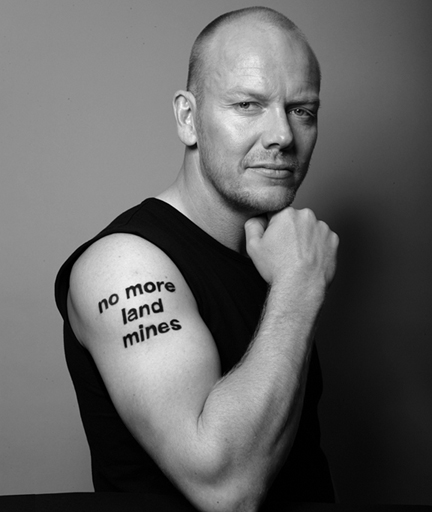


* Actually, the Bulgarian starting goalie gave up 77 goals, then the backup let in the remaining 5 in the final 1 minute, 25 seconds.
Subscribe to:
Posts (Atom)