tuque /tūk/ n Canadian English, var. toque [19th c. Canadian French, from the French toque, from the Basque tauka] 1 A close-fitting knitted cap, often with a long tapering end or tassel or pompom. 2 fig Something quintessentially Canadian.
souq /sūk/ n from the Arabic سوق var. souk 1 An open-air marketplace. 2 fig A central meeting place for the circulation of news and ideas.
Showing posts with label Hamas. Show all posts

Monday, January 25, 2010

Loose lips sink dictatorships


[Illustration from Bendib via Arabist]

The so-called Arab Satellite Charter is a proposal to create an Arab-wide media "monitoring" (a.k.a. censorship) outfit to police programming on Arab satellite TV. The proposal is being discussed today at a summit of the Ministers of Information of the 22 members states of the Arab League

Specifically, the three main (and privately owned) satellite stations the charter will target are: Al-Manar (the satellite mouthpiece of Hezbollah); Al-Aqsa (the satellite mouthpiece of Hamas); and Al-Jazeera (the Arab world's first and only independent satellite news network).

In unquestionably related news, these three satellite networks are among the most critical of Arab regimes and dictatorships, especially Egypt and Saudi Arabia, whose Ministers of Information hatched this censorship proposal so that they might be spared the daily criticism from popular media beyond their well-censored borders.

Qatar, in whose capital city Al-Jazeera is based, and Lebanon, home to Al-Manar, are said to be among the few Arab countries who oppose the proposal.

Thursday, March 19, 2009

"Between Fatah and Hamas, I choose Canada"

From the first in a series of political cartoons by a Palestinian artist. The strip is part of a Middle East political-cartoon exhibition called "Lighting Lamps" currently touring around the West Bank after visiting Egypt and Jordan:

Man A: "Are you Fatah or Hamas?"

Man B: "I'm Palestinian."

A: "Habibi… don't be clever. We're all Palestinian. Who are you with in the civil war?"

B: "I'm against the civil war."

A: "We're all against it, but it happened…..so who are you with?"

B: "I'm against both."

A: "Don't drive me crazy. You have to choose between Fatah and Hamas."

B: "Between Fatah and Hamas, I choose Canada."

And just for grins, here's another cartoon on the same subject:
Underneath the two straws is written in Arabic (obviously): Hamas and Fatah.

Tuesday, January 27, 2009

Hamas to Abbas: Which side are you on?

As new/old U.S. Middle East envoy George Mitchell embarks on his Comfy Chair tour of friendly Middle Eastern capitals -- hoping to inaugurate President Obama's peace push -- progress is being attempted on the Hamas-Israel truce front.

Hamas has reportedly offered a one-year truce, asking in return that Israel re-open all of Gaza's border crossings and allow Turkey to play a major role in international monitoring in the Strip. Hamas also wants/plans to take credit for all of the rebuilding in Gaza.

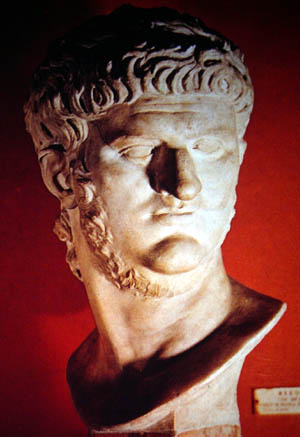
And Hamas also has a stern warning to its political rival, the PA and Prez Mahmoud Abbas: you're either with us, or your with Israel. Abu Mazen hasn't exactly come out of this latest conflict looking like Mandela. And after cracking down on Palestinian freedom of expression in the West Bank while Gaza burned and suffered, the PA increasingly looks weak, desperate, tyrannical and scared. Abbas is a fiddle away from seeing Nero's mug in his own mirror.

The titular head of the Palestinian nation has been feebly working on the peace process with Israel and the U.S., efforts that to Hamas's eyes culminated in Israel's bombardment and invasion of Gaza, a conflict the opining on which Abbas was largely absent. So Hamas wants to know: Hey Mahmoud, which side are you on?

(By the way, Abbas's term as President officially ended on January 9. Now ineptitude is not his only problem; his legitimacy is now officially in question. This won't be lost on his interlocuters when Hamas and the PA meet in Egypt next month for reconciliation talks.)

Thursday, January 15, 2009

Nasrallah: Israel has naughty plans for Hamas, Hezbollah


Some double entendre going on in the translation of Sheikh Hassan Nasrallah's latest speech about the Gaza war. I won't ruin it for you (it comes at about the 2:00 mark of the video), but it suffices to say that the perfectly good verb that Nasrallah uses with respect to what Israel hopes to do with Hamas and Hezbollah -- نقل which means 'to displace' or 'transfer,' 'translocate,' -- is translated a bit more creatively by the subtitlist.

Tuesday, January 6, 2009

Canadian media use human shields as shields against humanity

Thumbing the pages of Canada's major national dailies, it's not hard to discern that the editors prefer Israel's acknowledged defence to Hamas' accused offence on the topic of the current bloody brouhaha going on in Gaza.
Canada's largest-circulation daily, the Toronto Star, said on December 30 that "Israel is justified, but at what cost?" Expounding, the editorial sought a nuanced perspective:
"First let it be said that it is understandable why Israeli forces are attacking Gaza... It can be argued, of course, that the Israeli counterattack is disproportionate. Hundreds of Palestinians have been killed in the past few days, while only two Israelis have died in the latest rocket attacks."
Nuanced is the article, though not the difference between "Let it be said..." and "It can be argued..." And then...
"But that just points to the difficulty of mounting an attack against a covert force using civilians as shields."
A sweeping grab of all Gazan civilians as human shields? So much for nuance.

A few days later, on January 3, the Star sobered up:
"[M]oderate Palestinians are becoming radicalized by the lopsided war. This past week 430 Gazans, including women and children, were reported killed and 2,200 hurt; four Israelis have died."
The Star then argued that Canada should offer to send monitors to Gaza as part of a UN initiative. But the Star knows what happened to the last Canadian soldier stationed between Israel and its adversary.

The Globe and Mail's January 6 editorial was less than "measured"...
"The ground invasion of the Gaza Strip, to prevent the firing of rockets into Israel, is consistent with the Israeli government's prudent, limited war aims... If the Israel Defence Forces have to return again and again, to suppress new supplies of such rockets, so be it."
... and practically offered tactical advice to the IDF...
"The seizure of a few apartment buildings on [Gaza] city's outskirts, however, makes sense to provide the IDF with good vantage points... The priority is to root out as many rocket-launching positions and mobile militia squads as possible."
... and compared - very oddly - Israel's siege of Gaza with that of Stalingrad:
"...avoiding the horrific precedents of Stalingrad in 1942 and Manila in 1945."
Um, who besieged Stalingrad again?

A rather feeble January 3 editorial in the Globe mentioned that,
"... the broad Israeli public is sick to death of eight years of rocket attacks from Gaza."
... which is certainly true, but they neglected to mention anything about the broad Gaza Strip public and its metaphorical health vis-a-vis 42 years of Israeli oppression. The editorial concluded with the meek line,
"International pressure is needed to persuade both sides to accept an exit plan before an already deadly conflict takes a turn for the worse."
It's worse.

The National Post, which has opined on the recent conflict with the help of notorious Israel apologist Daniel Pipes, went to press on January 6 with an editorial that unambiguously called Israel "the victim" and further summed up Gaza's entire civilian population as human shields...
"Never mind that Israel's campaign in Gaza has been humane by military standards -- surgically killing hundreds of Hamas gunmen yet only a few dozen of their human shields."
"Humane" is a matter of opinion, but civilian deaths are a matter of fact lost so often by the press during the past week. At the time of this editorial, more than one hundred Palestinian civilians were confirmed killed.

Now it's up well over 200.

[Editor's note: Don't think for a sec that we condone or defend the deliberate use of human shields by combatants, nor willy-nilly apologize for the belligerence of Hamas. But the fact of the matter is that the Gaza Strip is not exactly the Ardennes Forest. Humans live everywhere in the Gaza Strip, densely. And while we would prefer to see neither side engage in armed conflict, and further deplore the deliberate use of human shields (such as Israel did during the siege of Jenin Refugee Camp in 2002), it is undeniable that residency in the Gaza Strip does not ipso facto make one a "human shield." There are 1.7 million residents in the Gaza Strip. We acknowledge that, just as we acknowledge that war ain't pretty and all people under oppression have a right to defend themselves, be they residents of a town under rocket fire or residents of a Strip under bombardment. We humbly argue that the mainstream media should acknowledge likewise.]

Israeli-Palestinian Cyberwar releases version 2.0

According to a story from ABC News, within 48 hours of the start of Israel's bombing campaign against Gaza, "anti-Israeli hackers based in Turkey, Iran and elsewhere violated the security of more than 300 [Israeli] Web sites and replaced the existing content with their own messages and images...

"[A]n American cybercrimes expert said thousands of Israeli and American Web sites have been defaced by radical Muslim hackers. A broad spectrum of sites, including those belonging to small businesses, a media company and a cargo airline, have been hacked into and plastered with anti-Israeli and anti-American messages."

There are reports of anti-Israel hacks originating in Turkey, Morocco, Iran, Europe, and other places, as well as from the Palestinian territories.

Israeli hackers are engaging their cyber arms, too. One group recently hacked into to the website of the Izz al-Din al-Qassam brigades - Hamas' military wing - and uploaded the Israeli national anthem.

Apparently Hamas is even offering rewards to hackers who come up with innovative ways to strike Israeli targets. Palestinian Islamic Jihad has its own cyber-warfare brigade.

According to one research paper from the Military Review (a U.S. Army journal), the Israeli-Palestinian cyberwar dates back to 1999. Then in 2000, just after the second Intifada began:
Israeli teenage hackers created a website to jam Hezbollah and Hamas websites in Lebanon. The teenagers launched a sustained denial of service attack that effectively jammed six websites of the Hezbollah and Hamas organizations in Lebanon and of the Palestinian National Authority. This seemingly minor website attack sparked a cyberwar that quickly escalated into an international incident. Palestinian and other supporting Islamic organizations called for a cyber Holy War, also called a cyber-Jihad or e-Jihad. Soon after, hackers struck three high-profile Israeli sites belonging to the Israeli Parliament (the Knesset), the Ministry of Foreign Affairs, and an Israeli Defense Force information site. Later, hackers also hit the Israeli Prime Minster's Office, the Bank of Israel, and the Tel Aviv Stock Exchange. [More]
And well, things have only gotten more sophisticated since then.

Monday, January 5, 2009

Gaza War: "Life must go on..."


If you haven't seen it, check out this blog called "Life must go on in Gaza and Sderot."

It's written by two men, one called "Hope Man" who lives in the Israeli town of Sderot, just east of the border with the Gaza Strip. The other, "Peace Man," lives in Gaza City.

They started their blog as electronic acquaintances wanting to provide 2 sides of the story of their perspective on the Israeli-Palestinian conflict. Sderot is the town in greatest danger of being struck by Hamas' homemade missiles, and Gaza is, well, Gaza.

Obviously this blog has gotten even more insightful in the past week or so.

Tuesday, December 30, 2008

That elephant in the bathtub? He speaks Persian

Q: How can you tell if there's an elephant in the bathtub with you?
A: By the smell of peanuts on his breath.

It's starting to smell like peanuts in the Middle East tub. So who's the elephant?

Israel's brutal attacks on Gaza have prompted some in the Arab media to start looking around the room.

Writing in al-Hayat, Mohammad Salah points his finger in the general direction of the elephant, arguing that ever since Hamas went down the road of dividing Palestine, the result has not been to the gain of only Israel:
"[When] Hamas took over the Gaza Strip... things became even worse; Palestinian disunity became a reality and there was no longer one Palestine, but two... Whoever hopes for the Palestinians to re-unite or rally behind a single leadership for the Palestinian people in its confrontation with Israel, peacefully or militarily, is deluded... Hamas will [not] relinquish its control over Gaza under any conditions, the PA has [no] authority to return the Gaza Strip to the rest of what remains of Palestine. Moreover, regional parties with influence over the Palestinian cause have not united behind the PA or Hamas; rather, they are divided between the two."
Who are these "regional parties"?

Jihad al-Khazen, sometimes a Hamas supporter, goes on:
"I still do not understand the reasons why Hamas - being the government - turned on itself and created an emirate for the Muslim Brotherhood in the Strip instead of trying to free the whole land then see what kind of rule people wanted in an election. Politics is not worthy of its name if it is not the politics of the possible. Hamas' policy in Gaza is suicidal."
The Arab world is becoming more divided, writes Jonathan Wright in the Egyptian Gazette, making eye contact with the elephant in the room:
"There is an Iranian plan, with Hamas and some of the Muslim Brotherhood, to stir up trouble in Palestine and Egypt. The Muslim Brotherhood, [Egypt's] banned-yet-influential group with one fifth of the seats in parliament, is in close alliance with Hamas, which began as a Brotherhood offshoot."
As usual, asharq alawsat editor-in-chief Tariq Almohayed draws a complete picture, pointing out that Hezbollah leader Sheikh Hassan Nasrallah spent half his recent speech - ostensibly delivered to criticize the Israeli assault on Gaza - inciting Egyptians to turn against their government, and the other half of his speech stirring up the usual bitterness dividing Lebanon.

Comparing the course that Hamas has taken with that of Hezbollah, Almohayed suggests:
"Shouldn’t Hamas turn away from Iranian assistance to strengthen it when all this does is torture the people of Gaza and subject them to brutal Israeli force?"
What is the emerging trend here? Let's go down the list of current events:
  • Lebanon: divided (Hezbollah with Syrian elements vs nationalist factions; and factions vs factions as a result)
  • Iraq: divided (ethnic and religious factions vs each other)
  • Palestine: divided (Hamas vs Fatah vs common sense and democratization)
Who gains with this kind of division in the Arab world? Israel of course. But just Israel?

What we're increasingly seeing from the Arab media is portrayal of the fact that Iranian support of the Muslim Brotherhood, of Hezbollah, of Hamas, of certain Shi'ite groups in Iraq, is ripping up the region.

And ironically, Israel's bloodletting only helps Iran achieve its goal of permanent destabilization. Because, of course, Israel has the same objective. The Arab media is quite practised at criticizing Israel - justifiably, for the most part - but not at identifying Iran as complicit in, for example, the emerging Israel-Hamas war.

As the scope of the bloody Gaza war becomes clearer, this is changing. That elephant in the bathtub? It's Iran.

Sunday, October 26, 2008

Gaza's Economy: In the Tunnels


Photos by Iyad Albaba

"Digging a tunnel requires three to four months; Abu Hassan and other workers use an electric machine to pull out piles of sand from a hole that is 21-meters deep. A father of seven children, Abu Hassan explains that 'what pushed me to work in these tunnels is the fact that over the past 16 months, I have been staying idle without job. How could I feed my family? I know it is dangerous work, but what can I do? I have no other option.'"

Read:
"Gaza's Flourishing Tunnel Trade" - electronic intifada
"Gaza's Tunnel Economy" - Al Jazeera [ENGLISH]
"Gaza's Tunnel Smugglers Stay Busy" - Christian Science Monitor
"Gaza's Smugglers Going Legit" - Palestine Media Center
"Gaza Tunnels Become an Industry" - BBC

Watch:
"Gaza Tunnels" - Journeyman.tv/You Tube

See:
Reuters photo gallery of Gaza tunnels

Friday, October 10, 2008

If democracy were a hockey team, what position would Hamas play?

If democracy were a hockey team, then Hamas would be the Bulgarian goalie who gave up 82 goals in one game.*

(Just go with me on this one...)

In an editorial commentary [ENGLISH] on the news site that is all but Hamas' official website - the Palestine Information Center - columnist Khalid Amayreh blasts the West Bank Fatah government's call for new, nationwide democratic elections as a "propagandist gambit" and a "sabotage" of democracy.

On the one hand, the article correctly cites various studies and sources which have concluded that Fatah elements backed by allies in the U.S. and Israel have conspired to foment civil unrest (if not all out war) ever since Hamas won the polls in the 2006 Palestinian elections. Mr. Amayreh calls the violent Hamas take-over of Gaza last summer a "counter-coup," arguing that:

"Fatah today remains the same Fatah that only reluctantly and under American pressure agreed to allow general elections to take place in 2006 and only because Fatah leaders seemed then certain they would win.

"However, when Hamas won the polls by a wide margin, Fatah couldn’t swallow the bitter bill and decided to embark on every conceivable act of sabotage in order to undercut Hamas and destabilize its rule. Some observers believe that Fatah took a secret decision to bring the would-be Hamas government down as soon as elections results were announced."

True, what happened after Hamas won the democratic elections of 2006 (and the fact that Hamas won is the surest sign of democracy in action) - the cinching of foreign aid, the polarization of Palestinian society, the bloody street battles between the factions - was certainly aided by Fatah's sore-losership.

But then again, the fact that Hamas participated in elections after erstwhile boycotting all Palestinian attempts at government smacks of political opportunism, not faith in democracy.

Mr. Amayreh also cites an overheard secret tape of the former Fatah strongman in Gaza, Mohammed Dahlan, telling comrades before the '06 election that he'll set Gaza "on fire" if Hamas wins.

Well that, too, is what happened. And it is no coincidence that, after more than a year of bloody skirmishes between Hamas and Fatah in Gaza, it was when Dahlan left for medical treatment in Egypt in June of '07 that Hamas went on the total offensive and overwhelmed Fatah troops in a matter of days, setting up what is basically a totalitarian "Hamastan" in the Gaza Strip.

None of this changes the fact that Hamas rightly won the elections in '06, nor does it change the probability that, should new elections actually happen now (if they even could happen fairly), and should Hamas win again, Fatah (and Israel, and the U.S.) would become even more desperate - perhaps more violent - in its attempt to crush Hamas and in the process take Palestine further away from peace and the end of the brutal Israeli occupation.

But what also must not be obscured is the fact that neither Hamas - nor Palestine partly because of Hamas - is operating as a democracy now. Yes, like that poor Bulgarian goalie, Hamas at least skated in the game. They are still skating occassionally: recently Hamas conducted a clandestine ballot to re-elect its Gaza leadership. But they aren't all-stars, much as they would have us believe.

And, as long as we're having fun with the hockey metaphor, if democracy were a hockey team, America would be Sean Avery, Israel would be Todd Bertuzzi's hit on Steve Moore, Sweden would certainly be Mats Sundin, and Iraq would be Jacque Plante's face. Canada would probably be Theoren Fleury. And Fatah would have to be Roy Keane.

* Actually, the Bulgarian starting goalie gave up 77 goals, then the backup let in the remaining 5 in the final 1 minute, 25 seconds.

Sunday, September 28, 2008

Israel Lobby to Harper: Do you still love us?

Prime Minister Stephen Harper had to engage in a bit of damage control when he scheduled our snap election on the major Jewish holiday of Sukkot.

Of course, not all Orthodox and proud, observant Jews are pro-Israel, and certainly not all in the pro-Israel camp are Jews (or even, um, pro-Semitic). But those who claim to speak for Israel's interests in Canada demanded clarification from the Prime Minister.

Luckily for Mr. Harper, his crush on Israel has a firm record.

Harper infamously called Israel's bombing of Lebanese civilians "measured."

Harper has enjoyed a "Toried Love" affair with the Asper family, the CanWest media moguls and staunch Israel supporters.

Harper has played Diaspora politics to appeal to Canada's pro-Israel electorate.

Harper has wooed Christian Zionists.

Harper accused his opponents of waving Hezbollah flags.

Harper was the first leader to denounce Palestinian democracy, and referred to Hamas as genocidal.

Harper agreed with the WMD threat from Iraq and supported America's war.

Harper doesn't like Ahmadinejad.

To be fair, Harper's Middle East policy is diverse. He did send his personal chef to Egypt in a "recipe sharing" exercise. And the man in the photograph shaking hands with Mr. Harper is King Abdullah II of Jordan (that's an Arab country).

Thursday, September 18, 2008

Where in the world is Khaled Meshal (going)?

The Kuwaiti daily al-Rai al-Aam reported [ARABIC] last week that the Damascus-based politburo chief of Hamas, Khaled Meshal, is being relocated to Sudan. (Hamas then denied the report.)

[Meshal is pictured here with Iranian president Mahmoud Ahmedinejad in 2006.]

Speculation is that:

A) Syria is tossing Meshal as a signal to Israelis that top-level peace talks should resume (Israelis and Syrians are still engaged in low-level peace talks via Turkey);
B) Syria is trying to disengage itself from the clutches of Iran (perhaps to advance said peace talks with Israel) and is sending a message to Hamas to get off Iran's teat or else;
C) Syria struck a deal with Meshal to lay low in Sudan for awhile while it makes a half-hearted effort to curry favour with Israel and the West.

While C seems all too predictable an answer for even casual observers of Middle East politics, consider this:

1. After Syrian President Bashar al-Assad participated in a summit last week in Qatar with leaders from France and Turkey to discuss advancing the peace process, Iranian state news exclaimed that "no effort can distance Syria from Iran." (A statement of fact that nicely doubles as a threat.)

2. At least some Israeli officials believe President al-Assad is genuinely interested in kick-starting serious peace talks again; and perhaps further that al-Assad really is fed up with Hamas.

3. And, a release by the US-based anti-Assad Syrian Reform Party alleged that Khaled Meshal's personal secretary in Syria, Hisham al-Labadani, was dragged from his car last week in the Syrian city of Homs and shot to death. While suspect as a news source, the SRP's claim is backed up by reports that Hamas is beefing up security around is Syria-based leaders for fear of assassination.

The SRP believes that moderate factions within al-Assad's regime are trying to strengthen ties with the West and sever the long-standing umbilical cord to Iran, and that al-Assad himself is playing both sides so as to not isolate his country from either Iran or the West until he can make the best move (for him).

So has Meshal packed his bags? Nobody knows for sure at the moment. The Hamas leader has lived in Damascus for more than 10 years, ever since Israel's Mossad tried and failed to assassinate him in Jordan. But with Hamas evermore dependent on Iranian funding, it is unlikely that Meshal's departure from Syria - if it happens - will be amicable.

For more analysis, read Ramzy Baroud's comment in al-Ahram [ENGLISH].